


Uncovering JAPA
The Evolving Municipal Bond Market for Housing

summary
- Municipal bonds are a key source of affordable housing financing, but increasing reliance on private conduit agencies has reduced public oversight and shifted power in the market.
- A small number of institutional investors now hold much of the housing municipal bond market, which can increase borrowing costs.
- Planners should consider who issues and owns housing bonds, not just how projects are financed.
Municipal bonds (munis) are often viewed as a catch-all policy solution to everything from environmental crises to affordable housing. Munis can fund single-family home mortgage subsidies as well as low-cost loans for development or rehabilitation of multifamily properties. But municipal debt must be understood as a long-term commitment. Careful deliberation and negotiation are needed for public projects to secure the best terms that taxpayers and tenants will repay.
In "Who Owns Municipal Housing Bonds? Asset Managers and the Affordable Housing Crisis" (Journal of the American Planning Association, Vol. 92, No. 2), Renee Tapp and Rachel Weber argue that governments' careful deliberation over public debt is too often bypassed in the rush to fund housing projects. The authors identify new players and concerning trends in the municipal housing bond market.
It is important for planners to understand the changing power dynamics in this market. The authors make clear that "if planners ignore who is issuing debt to fund their projects, they stand to pay more for longer and for fewer deliverables." By identifying the borrowers and the lenders in the muni market, the study aims to illuminate whether muni bonds are worth the price.
What are Munis?
Muni bonds are a quick way for local governments to borrow and fund public projects. Government and quasi-government agencies that borrow money are known as issuers, as they issue debt. The lenders are typically referred to as investors, despite not owning a share of the government, as with stock shares.
Historically, muni investors were wealthy individuals seeking stable, tax-exempt returns. In the last two decades, however, large asset managers and financial firms overtook individual investors in the muni market. These institutional investors use muni bonds as part of pension funds and retirement accounts like 401(k)s.
History of housing bonds
In 1978, Chicago issued the first municipal bond in the U.S. dedicated to housing. The money raised was used to subsidize residential mortgages in an era of energy supply shocks, rapid inflation, and housing unaffordability.
Muni bonds are repaid to investors through taxation or project revenue (e.g., rent from public housing). A General Obligation muni (repaid through taxation) requires a ballot referendum, while a revenue bond (repaid through the project or agency non-tax revenue) does not require voter approval. Revenue munis allow quasi-governmental agencies like public housing authorities to access lower interest rates on debt compared to private developers.
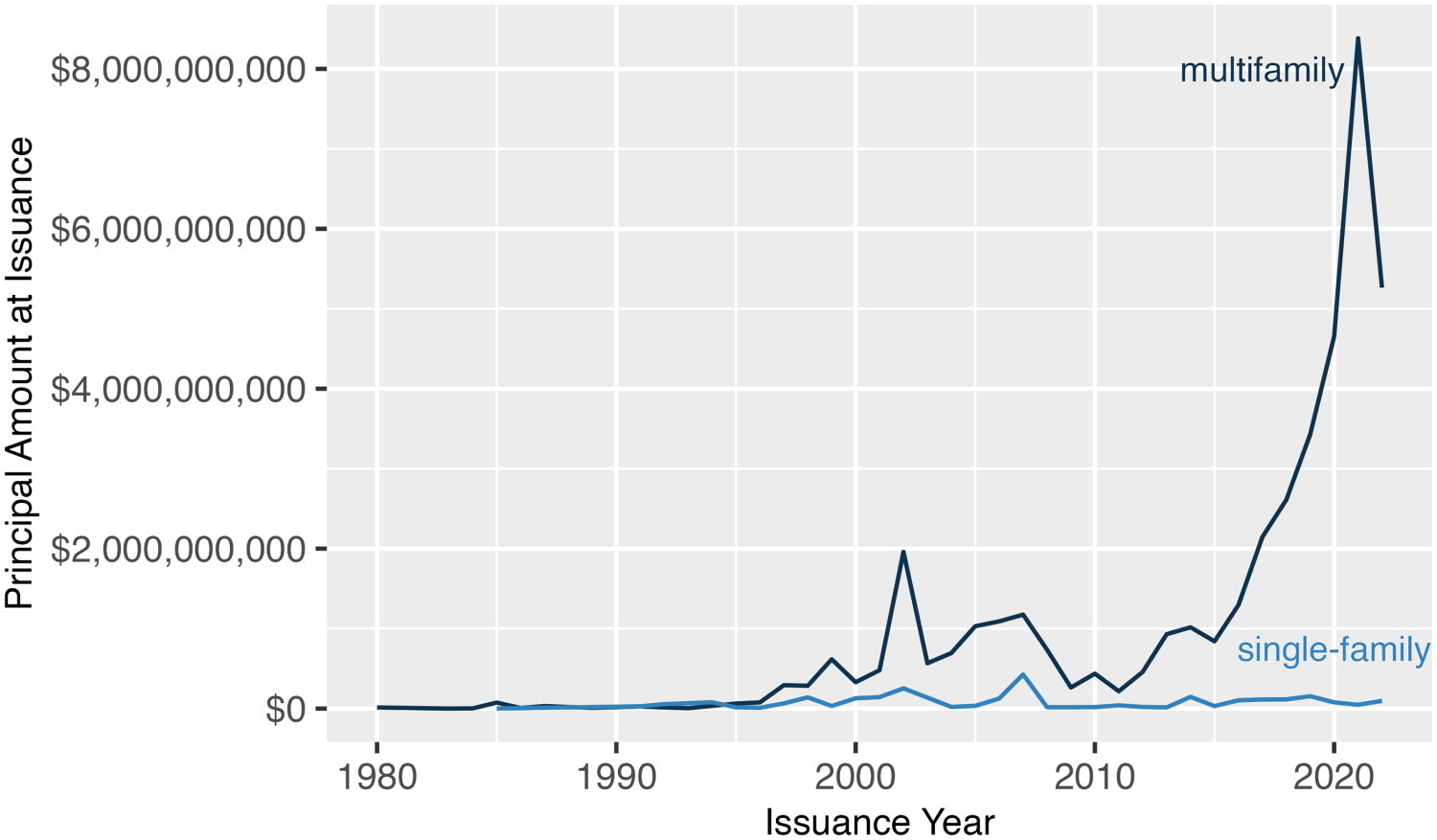
Figure 1: Municipal housing bond issuance 1980–2022 calculated as nominal value. (Credit: Authors, Data from Bloomberg Terminal (2022)).
Who Issues Housing Munis?
Just as the type of investor has shifted, muni issuers are no longer entirely public entities like local governments, public housing authorities, state housing finance agencies, or universities. The rising demand for affordable housing contributes to a burgeoning array of quasi-governmental agencies with the legal power to borrow through muni bonds without needing voter approval.
The 'Financialization' of housing
In the last two decades, corporate landlords, financial firms, and asset managers have reached further into all segments of the housing market. This is generally referred to as the "financialization" of housing. Research has made clear that these forces worsen tenants' living conditions and result in higher rents.
To sell bonds and raise the money for the loan, local government and quasi-government issuers choose between a competitive market approach or a streamlined process. The competitive market generally yields lower interest rates on loans, yet muni issuers prefer the streamlined process. Those higher borrowing costs are paid by taxpayers or through project revenue.
The authors identified 583 muni issuers with active housing bonds in 2022, totaling $44 billion borrowed. Multifamily housing bonds outnumbered single-family. Multifamily bond debt spiked in the past 10 years. Sixty-nine percent of multifamily bonds were issued after 2015 to support the construction of multifamily housing during the mounting affordability crisis.
While single-family bond issuers were largely government agencies, most multifamily issuers were conduit agencies, who critics allege "piggyback on the names of state and local municipalities," according to the study authors. In 2022, for example, a single conduit agency, the New Hampshire Business Finance Authority, was the issuer of 41 low-income housing projects spread across 16 states and Washington, D.C.
This illustrates why planners should know who is issuing a debt, as an estimated 75% of muni bonds in default (failed to repay their debt) originated from conduit agencies.
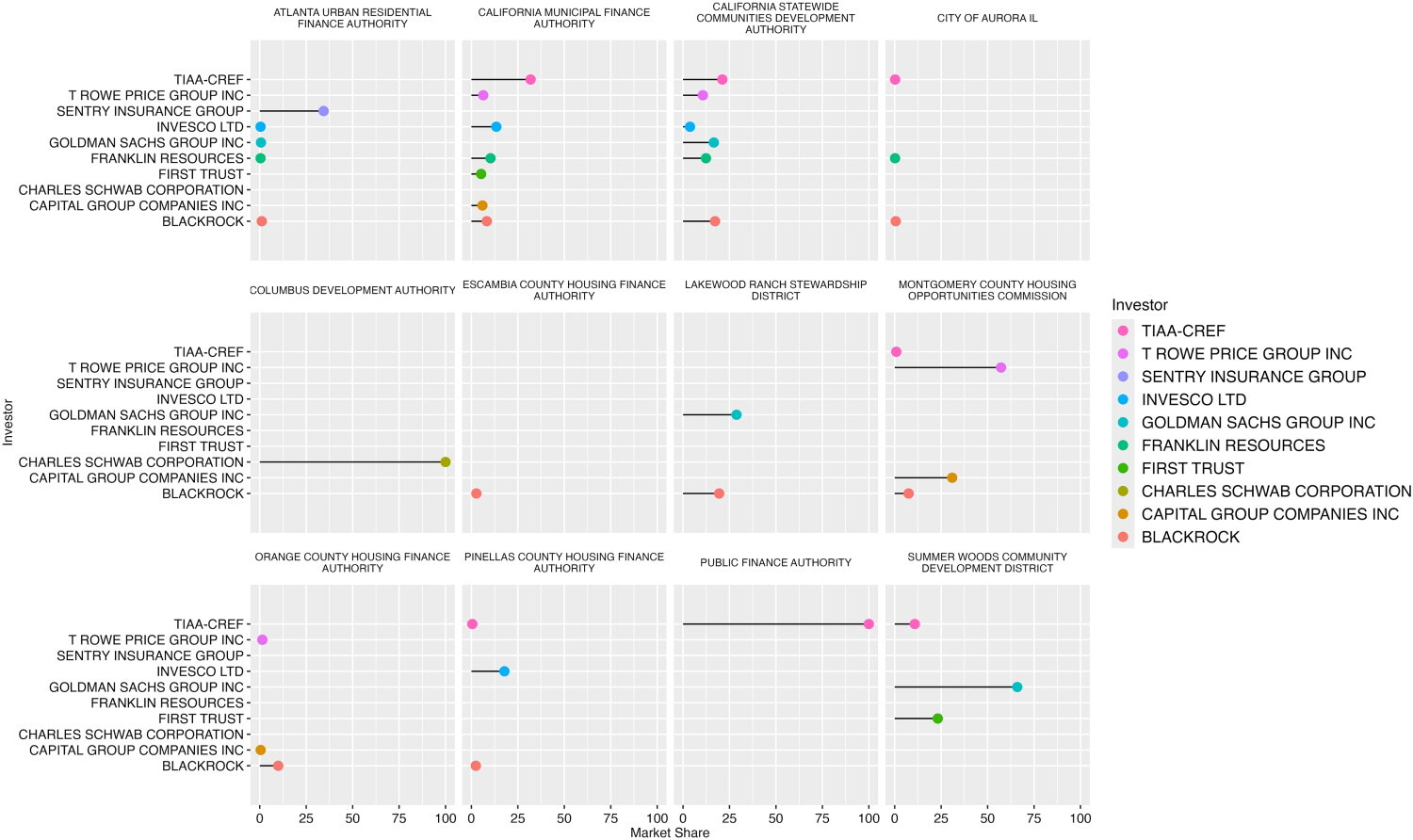
Figure 2: Bondholdings across single-family issuers. (Credit: Authors, Data from Bloomberg Terminal (2022)).
Investors in a Concentrated Market
Asset managers dominate the housing muni market with 81% of single-family investors and 74% of multifamily investors. However, investors' targeted strategies become more apparent when matched up with the issuer.
Nearly all of the outstanding single-family housing munis were issued by the 12 largest issuers. The top 10 investors own 68.8% of these top issuers' bonds. For some of these issuers' housing bonds, a single asset manager was the sole owner. Several prominent asset managers, Franklin Resources, Charles Schwab, Fidelity, BlackRock, and Vanguard, owned significantly more than the median holding of 7% of multiple issuers' multifamily munis.
Entangled ownership threatens to destabilize the entire market during times of crisis, like it did during the COVID-19 pandemic. Relying on debt to fund basic social services exposes taxpayers and local governments to the volatile decisions of a few large owners.
Concentrated ownership also raises concerns about higher-than-market interest rates paid by local governments. Certain muni intermediaries were found in court to have engaged in anti-competitive and illegal practices that artificially raised interest to benefit investors.
Concerns about Frankenstein Funds
Asset managers repackage municipal housing bonds with other kinds of munis and securities into mutual funds and exchange-traded funds (ETFs). Under the trusted name of municipal bond, these Frankenstein funds obscure who issued the bond and for what project. As the 2008-2009 global financial crisis revealed, even seemingly safe securities can contain risky loans that can destabilize the whole market.
For example, Vanguard, the largest investor in the New York City Housing Development Corporation, used mutual funds to lump together a well-regarded affordable housing bond with low-rated, "junk" bonds from across the state. But there are more than 50 national municipal bond mutual funds and ETFs that stack together less risky munis with riskier ones. In essence, this practice allows asset managers to "sell the affordable housing crisis to their clientele" for tax-exempt returns, according to the authors.
The tax exemption is another important piece to understand in the muni market. In short, munis "allow the wealthiest American households to capitalize on their local affordable housing crises twice over." Wealthy housing muni holders (whether individually or via asset managers' funds) first make money on increasing home values and then on munis' tax-exempt returns. The study authors assert the housing muni market contributes to the widening wealth gap between tenants and owners.
Key Takeaways
- Bonds are long-term loans, sometimes repaid decades after issuance.
- Private issuers increase risk in the market.
- Concentrated bondholding can create market instability.
- Concentrated bondholding can skew lending terms, costing local governments.
- Muni repayments provide tax-exempt interest payments to retirees and homeowners with retirement plans.
- Governments’ short-term access to capital should be weighed against longer-term priorities to support renters.
Top image: Photo by iStock/Getty Images Plus/ Maximusnd