


Uncovering JAPA
Where Do Families Go After Displacement?
The Journal of the American Planning Association (JAPA) turns research into action. All APA members have access to JAPA and its full archive.
summary
- Low-income households displaced by gentrification may move to lower-poverty neighborhoods but paying the consequences of displacement through a decline in their housing conditions and affordable housing choices.
- Planners can use neighborhood stabilization strategies to prevent displacement and identify destination neighborhoods where additional affordable and subsidized housing is needed.
- More detailed, national data on where displaced households move, including racial and ethnic patterns, can help planners better understand displacement and target policies to mitigate its impacts.
Researchers are only beginning to understand what happens after families are pushed out of gentrifying neighborhoods. Data on their new homes are key for targeted policies and planning tools to mitigate the harms of displacement. This study analyzes destination data while building on a body of quantitative and qualitative research showing that displacement of low-income families, in cities such as Columbus, Ohio, is a direct consequence of gentrification.
In "Gentrification-Induced Displacement, Destination Neighborhoods, and Destination Houses for Low-Income Households in Columbus, Ohio" (Journal of the American Planning Association Vol. 92, No. 2), Sahar Khaleel and Bernadette Hanlon offer critical insight into the destinations of people displaced by gentrification.
Where Low-Income Families Move After Displacement
Looking at the case of Columbus, Ohio, the authors found that displaced households often move to neighborhoods with lower poverty. Yet this is not a simple story of upward mobility. These families are more likely to move to houses with lower value, an indication that the destination house might be older, smaller, of poorer quality, or with all three combined. Moreover, there is often a lack of subsidized housing choices in their destination neighborhoods, indicating a limited affordable housing choice.
This means displaced families, while they might get to live in less poor neighborhoods, are paying the consequences of displacement through a decline in their housing conditions and affordable housing choices. The authors expect that low-income displaced households want to live in better neighborhoods, yet they must face a constrained housing market.
The study also indicates spatial outcomes of displacement. In Columbus, displaced low-income residents did not move to the suburbs, especially among renters. Further research, either through additional case studies or national data sets, would better inform the potential relationship between gentrification and suburban poverty.
Using Data to Track Residential Mobility
In tandem with traditional public data sets, the authors relied on a private data set to determine residential mobility. Data Axle Historical U.S. Residential Dataset are annual, with information on length of residence, own/rent status, home value, household income, and wealth for households. This dataset is not equivalent to a complete population census. There is a mismatch of about 15.5 percent of addresses across the United States, with slightly better coverage in this study area.
Data Axle data are also known to underrepresent certain groups, including low-income and younger people as well as renters. However, it is still considered among the best micro-data available in terms of population coverage, especially when compared to survey data.
In this study, the authors developed a panel data set that identifies the same household's place of residence each year from 2007 to 2017. This time frame was chosen based on available data.
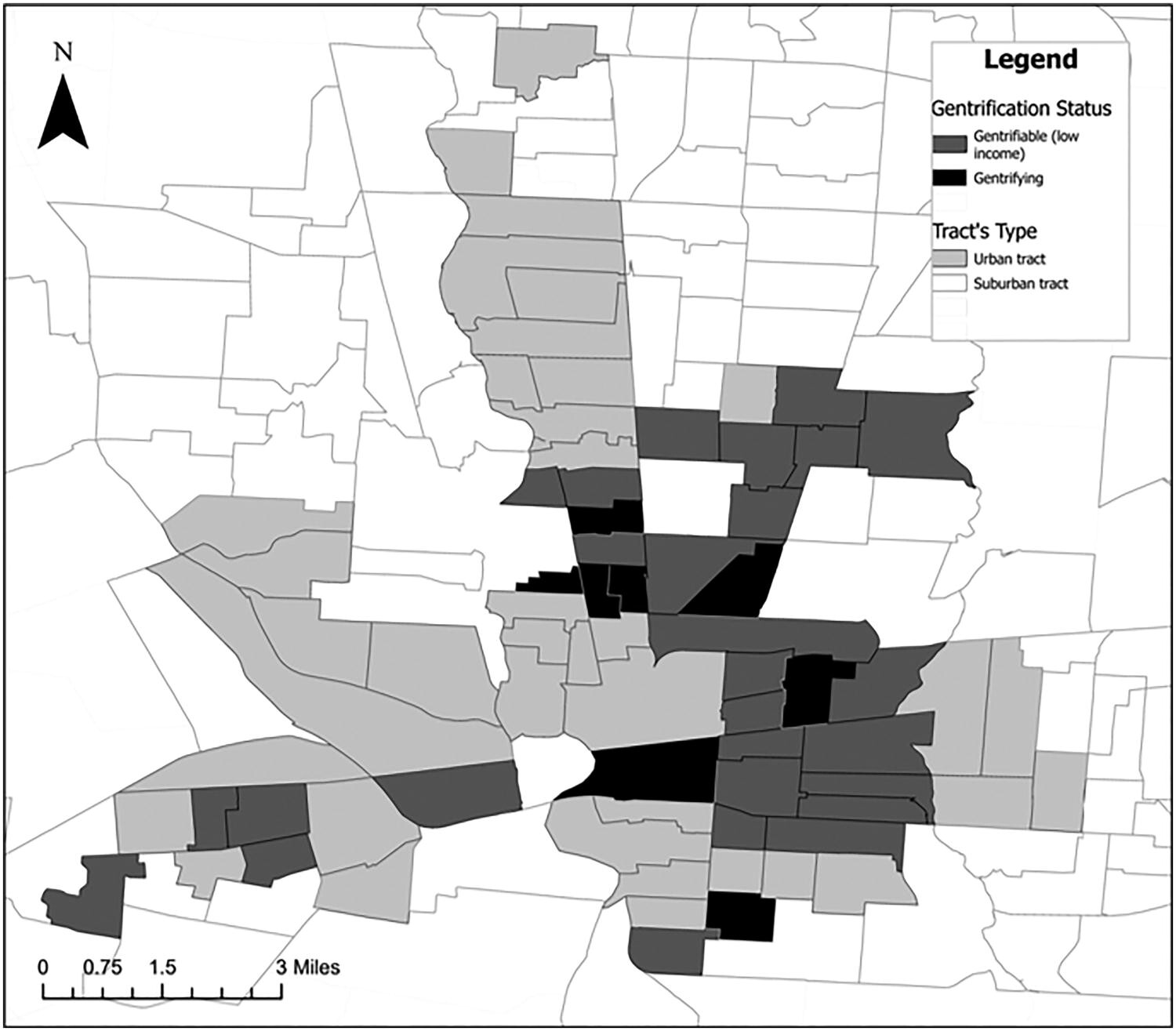
Figure 1: Columbus city tracts located in Franklin County, the low-income (gentrifiable) city tracts, and gentrifying tracts in black. (Credit: Authors).
Policies to Prevent and Mitigate Displacement
The authors define two stages where policy can help low-income households in neighborhoods experiencing gentrification. The first is the period before displacement. Commonly known as neighborhood stabilization policies, these include regulations limiting rent increases, tenant protections, legal representation for tenants facing eviction, and community land trusts. More broadly, the authors point toward preventative policies like increasing the affordable housing supply in gentrifying neighborhoods, including through subsidy.
The second stage for policy interventions is after gentrification-induced displacement. Policies in this stage require data on where displaced households might move. With this data, planners and policymakers can support affordable housing expansion in destination neighborhoods.
Specifically, destination data from studies like this one could inform location criteria for subsidized rental housing. This could be a key adjustment for the Low-Income Housing Tax Credit (LIHTC) program, which often concentrates units in low-income neighborhoods. As it stands, displaced low-income residents face a dearth of subsidized options when looking in lower-poverty neighborhoods.
The data used in this study did not include information on race or ethnicity. This prevents the analysis from touching on the racial variations of displacement and identifying supporting policies.
The authors call for similar research on a national scale. A larger-scale analysis would offer a more comprehensive understanding of the impacts of gentrification, including on broader regional changes including socioeconomic polarization and declining urban sprawl.
Top image: Photo by iStock/Getty Images Plus/ halbergman