

After Years of Waiting, Houston Park Gets a Fresh Start
summary
- Houston's $100 million Burnett Bayland Park redevelopment will expand green space and add heat-reduction and flood-mitigation features in the Gulfton neighborhood.
- Multilingual community engagement helped planners shape the park's design around residents' needs.
- An affordable housing strategy addresses displacement concerns alongside the park improvements.
For about a decade, Maria Hernandez picked up trash spilling from garbage cans and littering the path at Burnett Bayland Park in the Gulfton neighborhood of Houston, Texas. Hernandez and several other neighborhood moms hoped their efforts would help residents feel more comfortable, but families were so concerned about Burnett Bayland's safety that they let their children play in apartment parking lots instead.
As volunteers removed empty bottles and glass shards, they noticed a slew of other problems — limited lighting, outdated playground equipment, and an unsafe walking trail. Hernandez pleaded with local officials to improve the park's conditions, but few changes were made.
"It was a dangerous place to be, and that's the only park in the community," said Luis Guajardo, AICP, director of planning and community development for Harris County Precinct 4 Commissioner's Office, which includes Gulfton.
Now, 10 years later, Hernandez's wish is finally coming true. Burnett Bayland Park is receiving a $100 million makeover from Precinct 4, under the leadership of Commissioner Lesley Briones, with the first phase slated for completion this December and the final phase set to wrap up by 2030. Planners relied on extensive community outreach and partnerships with organizations like Madres del Parque, which was formed by Hernandez and other volunteers who held cleanup events at the park. Their efforts helped create a master plan tailored to the community's diversity.
The project will expand the park from 35 to 75 acres, plant roughly a thousand trees to reduce urban heat island effects and implement flood mitigation infrastructure. Upgraded soccer fields, an inclusive playground and an outdoor amphitheater will also take shape, among other amenities.
The project hasn't erased years of neglect, but it has restored Hernandez's hope that residents — many of whom are refugees and immigrants — will be cared for after years of underinvestment. "I believe [in] having a green space where there are beautiful flowers, trees and shade," she said. "At least [now] we can offer something to the community where they can feel a little bit of relief."
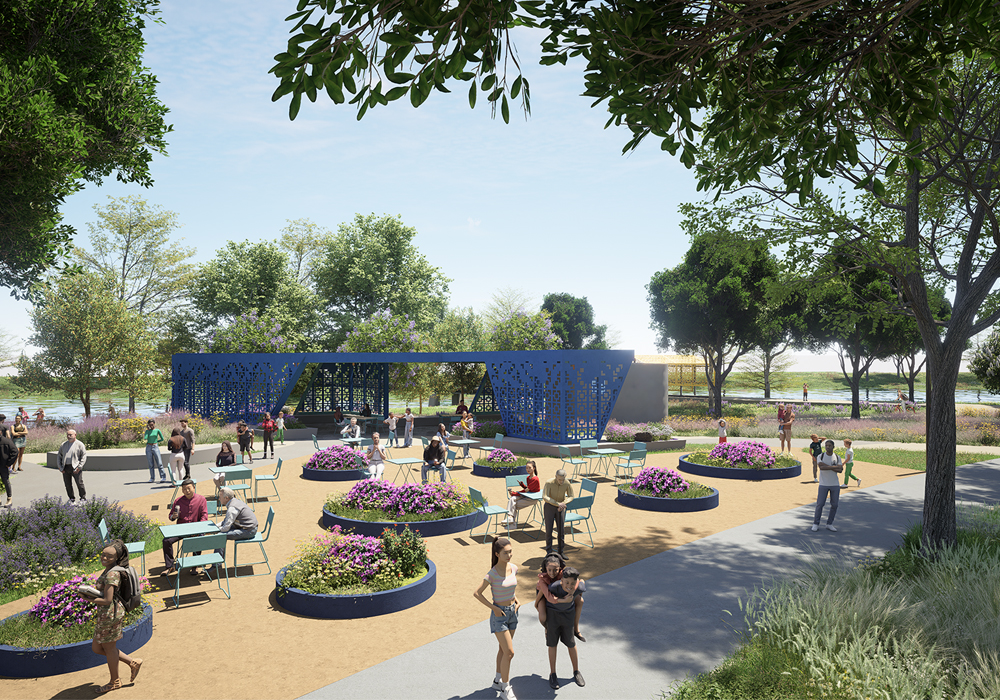
Rendering courtesy of SWA Group and Harris County Precinct 4.
Community-Driven Design Builds Trust
Known as the "Ellis Island of Texas," Gulfton encompasses nearly 3 square miles in southwest Houston. Nearly 60% of the neighborhood's 50,000 residents were born outside of the U.S., and more than 50 languages are spoken there.
Many residents are under-resourced, with 42% of households living below the federal poverty line. "You've got a lot of households that have service workers and/or families that are working two jobs just to keep pace with the cost of things," Guajardo said.
All those factors can complicate community outreach, and planners knew they'd need to take a multilingual approach to reach residents. Planners used seven languages, including Pashto and Tigrinya, for community engagement, allowing them to collect about 21,000 data points from surveys, speak-outs, and other activities that shaped the park's future.
At first, residents seemed hesitant to request anything at all. Guajardo remembers a workshop where planners asked for the community's boldest ideas, but they asked for the bare minimum, like functional restrooms and safe spaces. "There was some discomfort in thinking and dreaming that big," he said. "We had to help prod that out."
The kids in the neighborhood, however, who comprise a quarter of its population, happily provided their input, so planners began organizing child-friendly events with face painting and food trucks. "While the kids were having fun, we leveraged that to talk to parents for two or three minutes," Guajardo said. "We got a lot of feedback that way, [and] that really helped rebuild the community’s connection to the park."
Planners also had to consider at-risk children and teens who receive services at county properties adjacent to the park, including the Youth Diversion Center, the Opportunity Center, and Harris County Resources for Children and Adults. Many of these services focus on a restorative justice model, instead of a punitive one, and provide support to children navigating the foster system.
"They also wanted access to the park for their programming, for their staff, and for the youth," Guajardo said. "It all came together at the right time, and it's been wonderful to see. The park, in a sense, is the harbinger of what we're already trying to do through policy and all these other reforms."
Change Without Displacement
Residents also requested a community center that offered opportunities to learn how to start a small business, study English, or improve other skills. "We also heard concerns about gentrification and displacement," Guajardo said. "They said, 'We want to know if this park is for us, or if you're building it for someone else who's coming.' That was pretty powerful."
After the community shared their fears, planners incorporated an affordable housing strategy into the master plan. Youth who are unhoused — or in foster or respite care — were integrated into the strategy, as well as single-parent households, young children, young adults and recent immigrants.
The county then joined three of the city's tax increment reinvestment zones (TIRZs) and dedicated a portion of that funding to attainable housing. "Combined, these three TIRZs are projected to provide over $100 million in funding for affordable housing," Guajardo shared.
The first project underway is a mixed-income development, through the Harris County Redevelopment Authority and the Harris County Housing Finance Corporation. The development will offer 90 one- and two-bedroom units for older adults who earn between 30% and 60% of the area median income (AMI).
Additional funding from the TIRZs will help cover park maintenance and operations. "Once we were in construction or in design, we knew that was going to be a major sticking point, so we baked that into the negotiations of the TIRZ," Guajardo said.
More Than a Park
Finding $100 million in funding is no small feat, so the planning team partnered with the Precinct 4 Office of Innovation to leverage public-private partnerships and build relationships with potential donors. "The lesson for planners is sometimes knowing our limitations and being able to work with other professionals to reach those goals," Guajardo said.
While the planning team collected community feedback, the Office of Innovation explored federal grant opportunities and activated its sister nonprofit, Precinct4Forward, as an additional avenue for philanthropic dollars, said Anne Sung, chief policy and innovation officer for the precinct.
The Office of Innovation used storytelling to connect with local philanthropies. That meant not only sharing the story of Gulfton and its residents but also the opportunities that the park could create, Sung said.
"I think that our Precinct 4 planning team is just so rooted in understanding community, elevating community voice, and then doing a full community plan around any project," she said. "So, yes, it's a park, but it's more than that, and we heard that from the community, too."
The team received $11.3 million through the National Park Service Outdoor Recreation Legacy Partnership (ORLP) and $7.5 million from The Brown Foundation, Inc. Those grants, along with additional county resources, secured $50 million in public funding for the park.
"The next part is raising $50 million in private philanthropic dollars, which is extremely ambitious," Sung said. "But I must say that we have very generous philanthropies in Houston, who have a long history of investing in parks."
As of October, nine foundations and one individual have already given $22 million in philanthropic funding. The support for Burnett Bayland is especially poignant for Sung, who previously taught high schoolers in the community. "These are my babies; these are my former students and their families that we're serving here," she said.
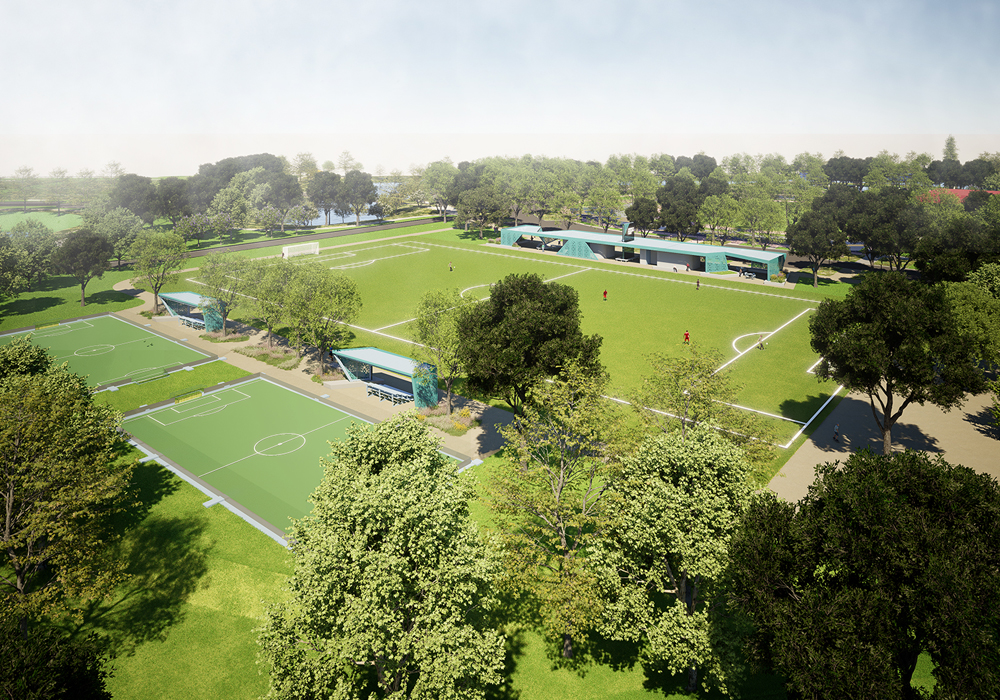
Rendering courtesy of SWA Group and Harris County Precinct 4.
'They're Valued Here'
By December, an elite soccer field and pavilion with restrooms and vending will be complete, said Courtney Cunningham, the precinct's senior engineering project manager for signature projects. The skate park will be upgraded, the detention pond will be finished, and two additional turf mini-pitches will be ready.
But Cunningham's favorite element is a three-level boardwalk, one of which houses a new community garden. Initially, residents hoped to swim in the pond, but the water quality made that unsafe. "We wanted to think about how we can ensure that we can get people as close to the water as possible without affecting anyone's health," she said.
As the project entered the design and construction phase, Cunningham and her team have updated residents on its progress and shared information at town hall meetings. "It's been a lot of sleepless nights, even sleepless mornings," she admitted. "I'm just very proud that we're delivering something of this magnitude to the community of Gulfton that is definitely going to impact change."
The park's impact on the community remains at the forefront of Guajardo's mind, too. He's spent a lot of time thinking about what another planner, Mitchell Silver, FAICP, once said during a Texas Chapter of the American Planning Association conference in 2023.
"He isolated a few powerful stories at certain parks in New York City when he was working as a commissioner," Guajardo said. "I looked deeper and realized what powerful stories existed here ... and I just couldn’t help but wonder [about] the stories that are going to be changed. Maybe it's a family with parents who are working two jobs just to keep up, but now the park that they live in is not a dumpster. Now, that park connects them better with the neighborhood. It shows that they’re valued here, and that their story is important."
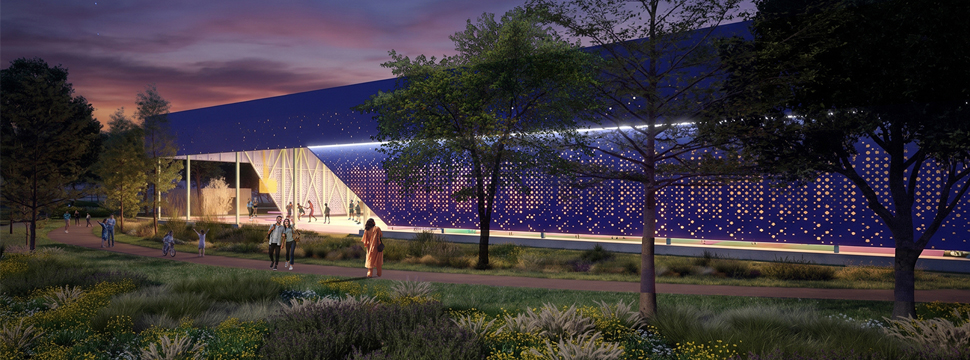
Top image: Rendering courtesy of SWA Group and Harris County Precinct 4.
ABOUT THE AUTHOR