

Planner Profile: Meet Jessica Iniguez
Planner Profile is a series spotlighting the unique experiences of our peers who are making a difference in the profession and at APA.
Jessica Iniguez is a David Bohnett Fellow at the University of California, Los Angeles, and a 2025 American Planning Association (APA) Foundation scholarship recipient. Iniguez is also a member of APA California, the LGBTQ and Planning Division and the Latinos and Planning Division.
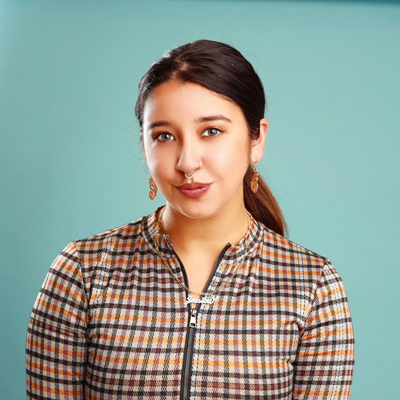
Photo courtesy of Jessica Iniguez.
How did you discover planning as a profession?
In my Compton, California, neighborhood, freeways, redlining and industrial zoning carved the land into sacrifice zones, where toxic air and lead-tainted water were part of daily life. My father came from a rural village in Mexico, where drought and failed crops forced him to leave land that had sustained our family for generations. Amid our neighborhood's damage, I found a community garden — one of Compton's few green spaces — where my father and I helped neighbors grow food in the concrete. That garden taught me urban space could be reclaimed for healing and self-determination, though I did not yet have a name for it.
I found that name working on energy policy with agricultural communities. As an Energy Equity Fellow at The Greenlining Institute, I worked with farmworkers whose homes sat outside the electrical grid, even though their labor fed the entire region. Families turned on their ovens for warmth in winter, risking their lives to stay warm. I testified before the California Energy Commission about what I saw, and we successfully advocated to extend the grid to those areas.
That work made the connection undeniable: the grid was not just a technical system that reached a home; it was a map of planning decisions about which communities were worth investing in. Watching agricultural workers go without heat, while the crops they grew sustained everyone else, showed me that planning decides whose safety gets built in and whose gets treated as optional. That is when I knew I wanted to help make those decisions, instead of watching them made around people like my father.
How has the Fellows Fund scholarship influenced your education in planning, and what impact do you hope it will have on your career and community?
The Fellows Fund scholarship came at a pivotal moment in my education. As a first-generation Chicana student and the daughter of a farmworker, I've always known that the communities most affected by planning decisions are often the least represented in the room where they're made. Graduate school is a significant financial stretch for students like me, and many of us end up working long hours outside of class just to stay enrolled. The scholarship eased that pressure. It meant I could focus fully on my studies at the University of California, Los Angeles's Luskin School of Public Affairs, take on coursework and research that genuinely challenged me, and be present in my program rather than constantly balancing school against survival.
The Fellows Fund also gave me the time and space to engage with the communities I care about. Because I wasn't stretched as thin, I was able to volunteer and work with mutual aid organizations, where I've seen firsthand how communities organize to meet their own needs when formal systems fall short. That experience has become central to how I understand planning.
Being selected for the scholarship also mattered on a personal level. It was a signal from APA that my perspective and path belong in this profession, and it connected me to a network of planners and mentors who have helped me see how wide that profession can be. I'm carrying that lens into my work in the Mayor's Office of Infrastructure and Climate Resilience, where I focus on energy justice solutions. My goal is to make sure the clean energy transition reaches the households and neighborhoods that have historically been left behind, and that those communities help shape it.
The Fellows Fund invested in me at a critical point, and I hope to pay that forward by helping build a profession that reflects and serves the people it plans for, including those it has too often overlooked.
What aspect of your work have you found most fulfilling?
The most fulfilling part is collaborating and co-creating a city's infrastructure alongside the communities who live there, and envisioning a better space together. As an Energy Equity Fellow, I organized an environmental justice tour in Willowbrook, Los Angeles, that brought policymakers face-to-face with injustices they had only read about. That tour led to a real partnership with Southern California Edison (SoCal Edison), putting a community-owned solar farm in Willowbrook's hands instead of leaving them dependent on a system that had long overlooked them. Later, leading the Movement for Solar Capacity and Leadership program, that same idea played out, as community members built their own solar systems and set their own usage rules.
That belief is what drew me to my current role as a David Bohnett Fellow, working in the Mayor's Office. Rather than advocating for investment from outside the system, I now work where these decisions are made, a full-circle moment guided by the same principle that has shaped my career: policy must be co-created with the people it affects. I work on Los Angeles's Climate Action Plan, coordinating across city departments, attending town halls, and working with external stakeholders to find real solutions for redlined, environmentally overburdened communities.
For me, the real measure of this work is whether the community members it's meant to serve are still part of shaping it. That instinct hasn't changed. It has simply grown to the scale of an entire city.
What planning effort/initiative are you most proud of that, as a planner, you helped make possible?
I am most proud of the pilot community-owned solar farm in Willowbrook. Seeing the neighborhood move the issue from an abstract policy problem to a concrete question about who gets to control their own energy future.
That tour became the foundation for a real partnership with SoCal Edison, and together we established a pilot community-owned solar farm. It was a small-scale project, but it represented something much larger: proof that a community historically treated as a site of extraction and neglect could instead become an owner and decision-maker in its own infrastructure.
As a planner, this project taught me that the most lasting change happens when a community moves from being a subject of planning to a co-author.
If you could create the perfect community, what would it be like?
My perfect community would start by healing places that once caused harm, treating repair as the first act of planning. Abandoned factories and vacant lots, once symbols of industrial growth that left pollution behind, would become urban gardens producing fresh food and solar hubs generating clean energy for the surrounding neighborhoods. These would not just be functional spaces; they would be community hubs with playgrounds, farmers markets and sustainability workshops. Energy in this community would be locally owned. Every household would have reliable access to heat and power, and the community would set its own rules around how that energy is used and shared, building local capacity rather than dependence.
Housing would reflect the same values: a mix of housing types and lot sizes so people of different means could live there and age in place without being displaced, unlike the freeways, redlining and industrial zoning that fractured neighborhoods like the one where I grew up.
Most importantly, this community would be planned with its residents, not for them. Urban planners would listen more than they design, treating community members as the experts on their own lives. Policies would be intersectional by design, tying environmental regeneration to economic opportunity, so that revitalization strengthens the people already there.
What is your favorite third place?
My favorite third space is a cat café. There is something disarming about a room where the whole point is to slow down. Having a cat wander over and decide, on its own terms, whether you're worth its attention only adds to that. I go there with a coffee and often a book, and I find it to be one of the few places where I can be fully present without needing to perform productivity or hold up a conversation.
Want to be the next Planner Profile? Fill out this form to help us get to know you better.