

Oct. 1, 2026
In Aurora, Illinois, the problem became obvious to planning director Tracey Vacek last spring, when residents at the city’s edge complained of a hum from a nearby data center that sounded like “a white noise machine in their ears all the time.”
A thousand miles east, in Mansfield, Massachusetts, it dawned on planning director Sarah Raposa, AICP, during a December 2025 meeting that the town’s surfeit of industrial areas and cheap municipal electric supply would be a beacon for data center developers.
Meanwhile, in Oklahoma City, planning director Geoff Butler, AICP, reluctantly pushed for a moratorium for data center development this past April, after he realized the pace and scale of applications for these gigantic projects were overwhelming his staff. “Until a hyperscale data center comes to you, you don’t necessarily realize it’s going to be necessary for you to engage with your own code,” Butler says.
As the spread of data centers accelerates, the political and financial pressure behind expanding these powerful computing centers has put planners in a bind, forcing them to wrangle with competing factors like economic development, placemaking, land use regulations, and resource stewardship. They’re made to evaluate regional water and power resources — utilities that are often beyond their control — while needing to navigate delicate issues of transparency and trust.
Complicating matters even more, state preemption laws can often limit planners’ power, says Justin Kollar, a PhD candidate at the Massachusetts Institute of Technology (MIT) and author of “Planning Under Preemption: State Power and Local Authority in the AI Data Center Era,” a February 2026 article in the Journal of the American Planning Association.
“It’s a terrible situation,” says Mary Ann Dickinson, CEO at Dickinson Associates and a former policy director at the Lincoln Institute of Land Policy. “It’s a painful process, there’s no trust, and nondisclosure agreements make it worse.”
Development at a different scale
Data centers have been around for decades; Virginia became a global hotspot for them in the 1990s because of the growth of a then-fledgling company called AOL. But the emergence of new hyperscale data center campuses to train and power AI has radically changed the calculus. Global real estate services firm JLL found that new data center occupancy has doubled in the past year, with $800 billion in spending committed to new construction.
A building type that was once as large as a small office building has now ballooned into sprawling campuses that include 7 million square feet of data center space and can use 1 gigawatt (GW) of power — an amount that could be generated by 400 wind turbines or one small nuclear reactor, which is enough to power more than 800,000 homes. The technologies used to chill the endless racks of high-end servers and computer chips are also very thirsty; some sites can use millions of gallons of water a day.

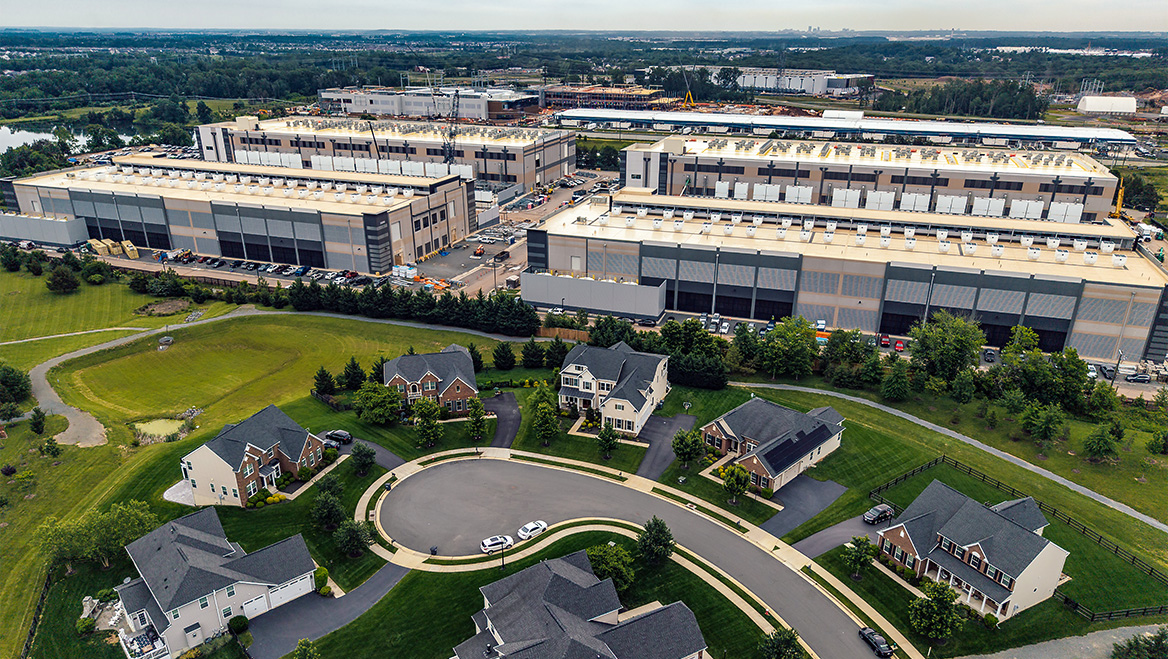
In Herndon, Virginia, a baseball field backs up to a data center with a utilitarian exterior similar to that of other Loudon County facilities.
Nearly 4,800 data centers are in operation or in development in the U.S., according to the Data Center Map. Currently, Cleanview, a marketing intelligence company, estimates roughly 1,900 of those are in the planning pipeline. Goldman Sachs forecasts the power demand for these buildings will double to 66 GW by 2027.
This has rendered previous zoning and building codes, which often classified data centers in the same category as logistics warehouses or as by-right development, insufficient. They limit planners’ ability to respond to community sentiment, which increasingly skews negative. An Embold Research poll conducted in May found more than 7 in 10 Americans would oppose the construction of a data center near their home.
Planners in Aurora experienced this firsthand. While the city has hosted data centers since 2012, new proposals, with buildings five times the size of previous projects, put residents on edge. Spiking electrical bills, which the local utility blamed in part on data center demand, didn’t help, says Alison Lindburg, the city’s director of sustainability. When she presented data on the tax revenues from these developments at a city council meeting and public open houses — about $1 million for a fully operational 100-megawatt site — concerns about water and energy costs outweighed any budget boost.
Putting a pause on permits
One answer to encroaching data center development has been moratoriums, temporary pauses to governmental procedures, allowing planning staff to research and rewrite their own codes. In early 2026, Kollar’s research found just a few dozen moratoriums nationwide. Now, there are roughly 400.
That’s the route Vacek and her colleagues in Aurora took to update their zoning code and regulations. They enacted a six-month moratorium in September 2025 and spent half a year consulting with residents, community groups, data center developers, planners, and industry experts.
During a moratorium, cities can learn more about data center operations during site evaluations, says Michigan planning consultant Kyle Mucha, AICP. That can mean coordinating with local utilities, checking if new power lines or substations need to be built, seeing if the land and easements are available, finding out whether a water table study is needed to understand the drawdown of local water supplies, and understanding the impact on agricultural activity.
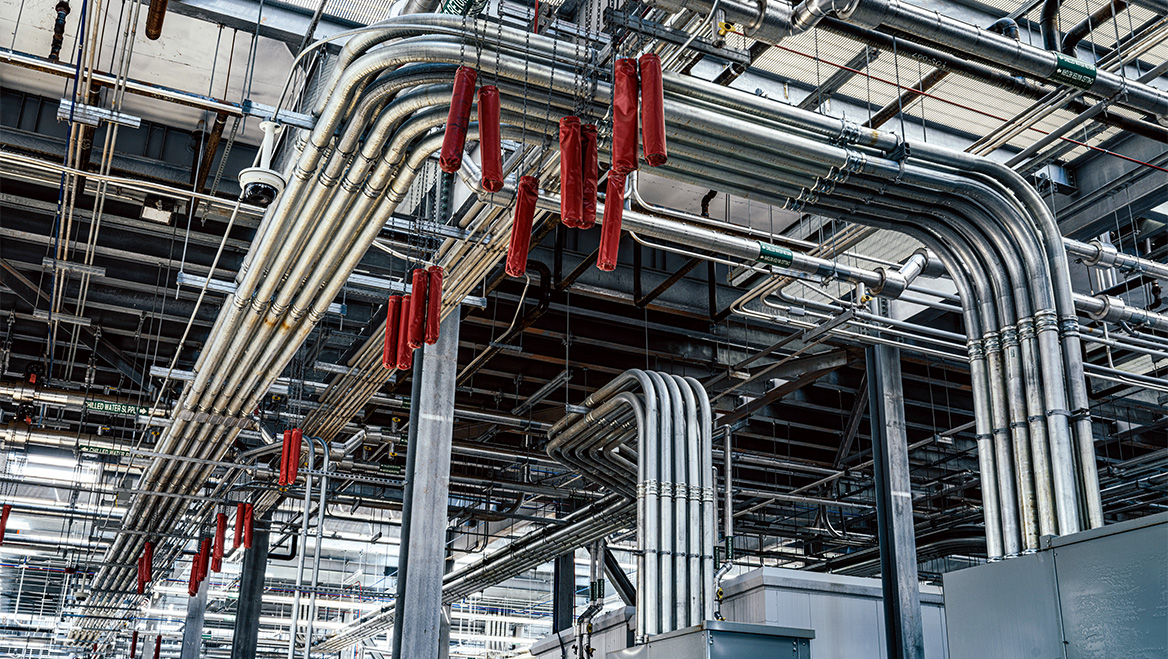
Hundreds of pipes snake through the mechanical yard of a data center in Ashburn, Virginia.
It also includes a crash course in the challenges of cooling data centers. Anyone who has felt their smartphone heat up in the summer knows that computer processing units (CPUs) can overheat, says Brett Gracely, a water planning practice leader at Plummer Associates.
Data centers tackle that cooling challenge on a massive scale: Evaporative cooling, the method used by air conditioners, pumps water through the data center, where it evaporates and pulls heat from the machines. It’s more energy efficient than other methods but requires much more water. Newer systems use what’s called closed-loop cooling, running a fixed volume of water through tubes adjacent to servers to draw away heat, akin to how a car radiator works. It requires much less water, but also higher energy bills to circulate that cooling liquid.
Dickinson suggests cities push for data centers to be considered wholesale water customers, forcing them to pick up the cost of any needed infrastructure investments.
Achieving realistic regulations
After talking with more than a dozen city planning groups about their experiences with data centers, Aurora planners formed a task force that crafted a new set of ordinances, following Vacek’s view that they needed to be realistic, reasonable, and restrictive enough to address residents’ stated concerns. She believes data centers can be beneficial with proper regulation.
First, any new proposals in the city must obtain a conditional use permit (CUP), which requires numerous public announcements, meetings, and approval by a majority of the city council. New facilities are limited to specific industrial areas and special planned development zones. Aurora also banned evaporative chilling to conserve water resources.
The city’s zoning code also asks for more transparency from these developments. Each needs to run with 25 percent of its energy supplied by renewable power and include battery storage backups. Siting restrictions depend on the cooling methods used; ground-mounted coolers aren’t as loud as roof-mounted units, so each has different residential setback requirements that reflect differing noise levels. Because Aurora will be monitoring vibration and noise levels at sensitive sites such as schools and residential developments, it is incentivizing developers to change. The developer of the CyrusOne data center, for example, is spending $30 million to mitigate noise, says John Curley, Aurora’s chief development services officer.
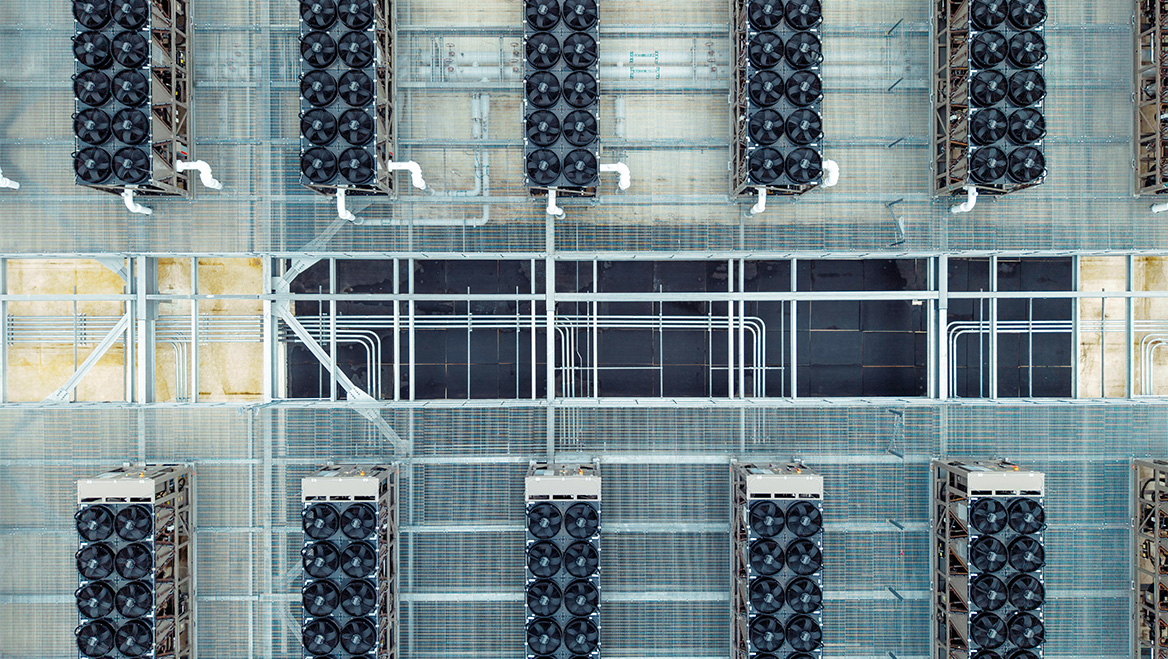
Water-cooling systems are housed on the roof of a Virginia data center.
Aurora’s planners found a clever way to monitor water and energy use. The city can’t place caps on resource use, but in addition to demanding transparent data on proposed water and electricity use up front when projects submit for a permit, they require strict limits on, and periodic reporting of, water and power use efficiency at the operating facilities.
It’s not retroactive, says Vacek, but new CUPs will include language on fines and penalties, including possible permit removal, for failing to meet those benchmarks.
“We realized we had to respect land use rights and also had to really look at the legality of our requirements,” Vacek says.
Code changes aren’t one-size-fits-all
Other communities have adopted different regulations and rules for data centers. In Mansfield, for example, a new set of zoning amendments limits development within certain industrial and planned business districts and allows only relatively small facilities that use up to two megawatts of power, says Raposa, the city’s planning director.
A data center project in a different Massachusetts community that was expanding into an adjacent residential area prompted Raposa to consider where data centers could be placed in Mansfield. Concerns about resource use — because Mansfield has a municipal water and electric system — led to the limit on the size of a site’s electrical draw, which seemed easier to mandate than water usage.
Projects need to be permitted, meet annual reporting requirements around power usage, and renew their permits every five years.
“We did see very small, traditional data centers as potential economic development,” Raposa says. “This can be a benefit on our terms.”
In Lynchburg, Virginia, city planner Rachel Frischeisen helped shepherd a series of updates to the city’s data center ordinance, requiring developers to disclose energy and water usage and transmission plans and mandating a majority vote from city council to receive a CUP.

APA’s KnowledgeBase Collection on data centers catalogs resources that demonstrate how local and regional agencies are addressing plans and regulatory considerations.
Alarmed by the expansion of data center development in the area, Frischeisen initiated a staff review of existing policies to right-size the response. Lynchburg wasn’t going to attract massive mega campuses, but it was still close enough to the Northern Virginia data center boom that it needed updates.
Increasingly, planners are seeing data center rules as an ongoing conversation with the community. Aurora’s new ordinances weren’t greeted as victories by either opponents or developers. Both sides were unhappy, which planning director Vacek views as a sign they got it right.
From a different lens, though, Dickinson believes communities are “up in arms” because “they’re afraid they’re losing their sense of community.” It’s a good thing, she says, that people are starting to have conversations about how they want their cities to grow in the future.
Meanwhile, MIT student Kollar says several states are considering laws that would mandate more community benefit agreements for these kinds of projects in the future — something Aurora planners believe can make data centers
a better deal moving forward.
“It’s important to have regulations that challenge the industry to work on technology that’s actually improving the lives of neighbors,” says Curley, of Aurora, “because you know they’re going to work on the technological improvements that help their bottom line.”
Images in this article are from “Dark Fiber,” a personal project by Washington, DC, photographer Stephen Voss. He is working on a book of this work to be published in 2027.
RECOMMENDED ARTICLES