
Sponsored Content
A Tool to Support Community Resilience: The AARP Livability Index™ Platform

Building communities that are resilient against disaster requires preparedness and informed decision-making. Among its 61 indicators of livability, the 2025 release of the AARP Livability Index platform includes two measures of community disaster resilience: Local Multi-Hazard Mitigation Plans and Natural Hazard Risk. These two measures, which are based on two Federal Emergency Management Agency (FEMA) datasets, provide insight into which hazards a community should be prepared for and whether the community has a current hazard mitigation plan.
Emergency Preparedness in the AARP Livability Index Platform
Both measures included in the platform, and emergency preparedness broadly, are inherently intertwined with livability. Including disaster-focused datasets in the AARP Livability Index platform emphasizes the connection between community resilience and livability. Effective planning makes communities more livable by reducing disaster impacts and speeding recovery. The Index, along with resources like the AARP Disaster Resilience Toolkit, empowers people to be more prepared for when disaster strikes.
In the 2025 update of the platform, AARP adds the Natural Hazard Risk from FEMA's National Risk Index (NRI) to the community characteristics. Community characteristics are not included in the scoring. However, including them allows users of the AARP Livability Index platform — people considering a move to a particular community, for example — to access valuable information on a variety of aspects of that community, such as the type and severity of hazard risks. The 2025 update maintains the Local Multi-Hazard Mitigation Plans indicator in the Environment category.
Local Multi-Hazard Mitigation Plans
The Local Multi-Hazard Mitigation Plan measure identifies whether communities have a current FEMA-approved plan. A plan is required for communities to receive certain FEMA funding and is essential in identifying and reducing local risks.
A current hazard mitigation plan may be an indication that a community is proactively planning for disasters and investing in long-term resilience. This is especially important for older adults who may rely on local infrastructure, emergency services, and continuity of care during and after a disaster. The livability of the entire community is also improved by having a current plan because it equips community leaders and emergency responders with a guide to critical infrastructure, evacuation plans for residents, and other information for effectively prioritizing resources during the moments immediately following a disaster.
FEMA maintains a national map displaying the status of mitigation plans (Figure 1).
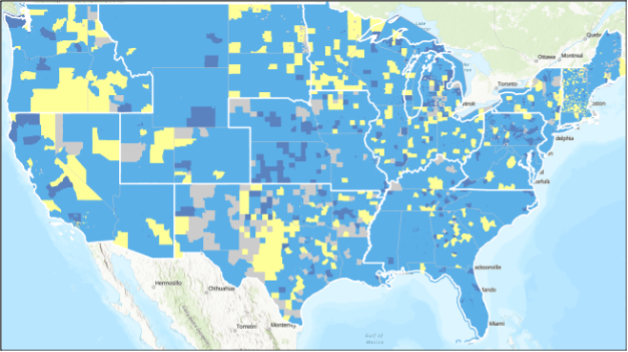
Most states have at least one county or region with an expired plan, with some experiencing more gaps than others.
Natural Hazard Risk
The NRI is a dataset that evaluates a community's relative exposure to natural hazards through an estimated risk score. This score accounts for the frequency and severity of hazards, expected annual losses, social vulnerability, and community resilience.
Older adults are disproportionately impacted during disasters due to limited mobility, medical needs, and potential social isolation. NRI data helps residents and urban planners assess their community's exposure to various natural hazards such as fire or flooding. The inclusion of social vulnerability should help planners steer engagement and resources towards areas with the greatest need.
An analysis of the NRI reveals that eight out of 10 states with the highest average county risk score were among those with the most shoreline. Coastal regions often have large population centers with major infrastructure vulnerable to such threats as hurricanes, tsunamis, and flooding. Coastal flooding risk is one of the 18 natural hazard risk maps made available by NRI data (Figure 2).
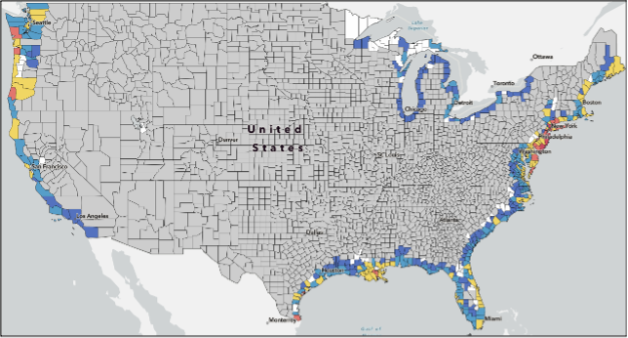
Figure 2: National Risk Index Coastal Flooding Risk, September 2025. Source: "The National Risk Index", FEMA, accessed September 2025.
Why Emergency Preparedness Matters for Livability
Emergency preparedness promotes aging in place and resilience for all people. Communities begin with an understanding of their unique natural hazard risks. This knowledge supports effective planning and enables investment in infrastructure appropriate to the risk.
Regular hazard mitigation planning can help mitigate loss in the event of a major disaster. The AARP Livability Index platform is a resource for local governments and community residents to prepare for disasters and invest in disaster resilience.
ABOUT THE CONTENT AUTHOR AND SPONSOR: AARP

AARP is the nation's largest nonprofit, nonpartisan organization dedicated to empowering Americans 50 and older to choose how they live as they age. With a nationwide presence, AARP strengthens communities and advocates for what matters most to the more than 100 million Americans 50-plus and their families: health security, financial stability, and personal fulfillment. AARP also works for individuals in the marketplace by sparking new solutions and allowing carefully chosen, high-quality products and services to carry the AARP name. As a trusted source for news and information, AARP produces the nation's largest circulation publications, AARP The Magazine and AARP Bulletin. To learn more, visit www.aarp.org/about-aarp/, www.aarp.org/español, or follow @AARP, @AARPenEspañol, and @AARPadvocates on social media.
By Paul Lingamfelter, AARP Public Policy Institute
Top image: Photo by Getty Images/milan2099