

Chicago Planners Infill West Side Train Station After 75 Years
summary
- The Chicago Transit Authority (CTA) reopened a Green Line train station after 75 years, adding an infill elevated stop at Damen Avenue and Lake Street.
- Planners at the CTA, Chicago Department of Transportation (CDOT), Cook County, and other agencies worked together to get the 1892-era station back on track.
- Designed to handle post-event surges near the United Center, the new station is averaging roughly 1,000 weekday riders.
Transportation planners in Chicago and Cook County are hoping a new infill elevated train station on the city's west side can be a catalyst for future growth.
The Green Line station at Damen Avenue and Lake Street had been closed for 75 years because of the influx of personal automobiles and the construction of an expressway a few blocks south. But community advocacy and the anticipated growth in the area helped make it an ideal spot for infill, says Quinn Kasal, senior manager, strategic planning for rail at the Chicago Transit Authority (CTA).
To get the project to the end of the line, CTA planners worked with the Chicago Department of Transportation (CDOT), the Cook County Department of Transportation and Highways (CCDOTH), and other city agencies.
"An infill station in a neighborhood is one of the more impactful investments you can make in a community," Kasal says. "It provides service every day and night. And, if you look at it from a community development perspective, it's something that can really catalyze business activity, potentially bring more residential development densification, or create a hub for mixed-use development and walkability.
"A transit station can really be the thing that anchors that for a community."
Reviving a Century-Old Train Station
Originally built in 1892, the Damen and Lake Station began declining in the 1930s before it was eventually closed. But CTA identified it as an infill opportunity in the late 2010s, after having success with the model in other parts of the city. CDOT took over after CTA finished the initial planning, and Perkins + Will was brought on to handle the design and construction.
"You could see the positive and negative impacts of infrastructure and how that affected the community," says Bryan Schabel, design principal at Perkins + Will. "We knew this [project] would help the community."
Several community meetings were held with a local alderman before the construction started. During those sessions, residents asked for some privacy from the station, resulting in a door not being put in on the west side of the station. "It's great that they had that input, and all of these things allowed the site to be utilized in a way that makes a lot of sense for everyone," Schabel says.
When it was completed in summer 2024, the building also featured a mural by local artist Fo Wilson; integrated bike and bus connections; and low-carbon building materials, including a green roof that reduces rainwater on the sewer system and tree plantings to reduce the urban heat island effect.
It was also built without shutting down the Green Line for an extended period. "Because it's been so successful, hopefully it will be a model that can be replicated in other locations around the city," says David Rader, a Perkins + Will architect who worked on the project.
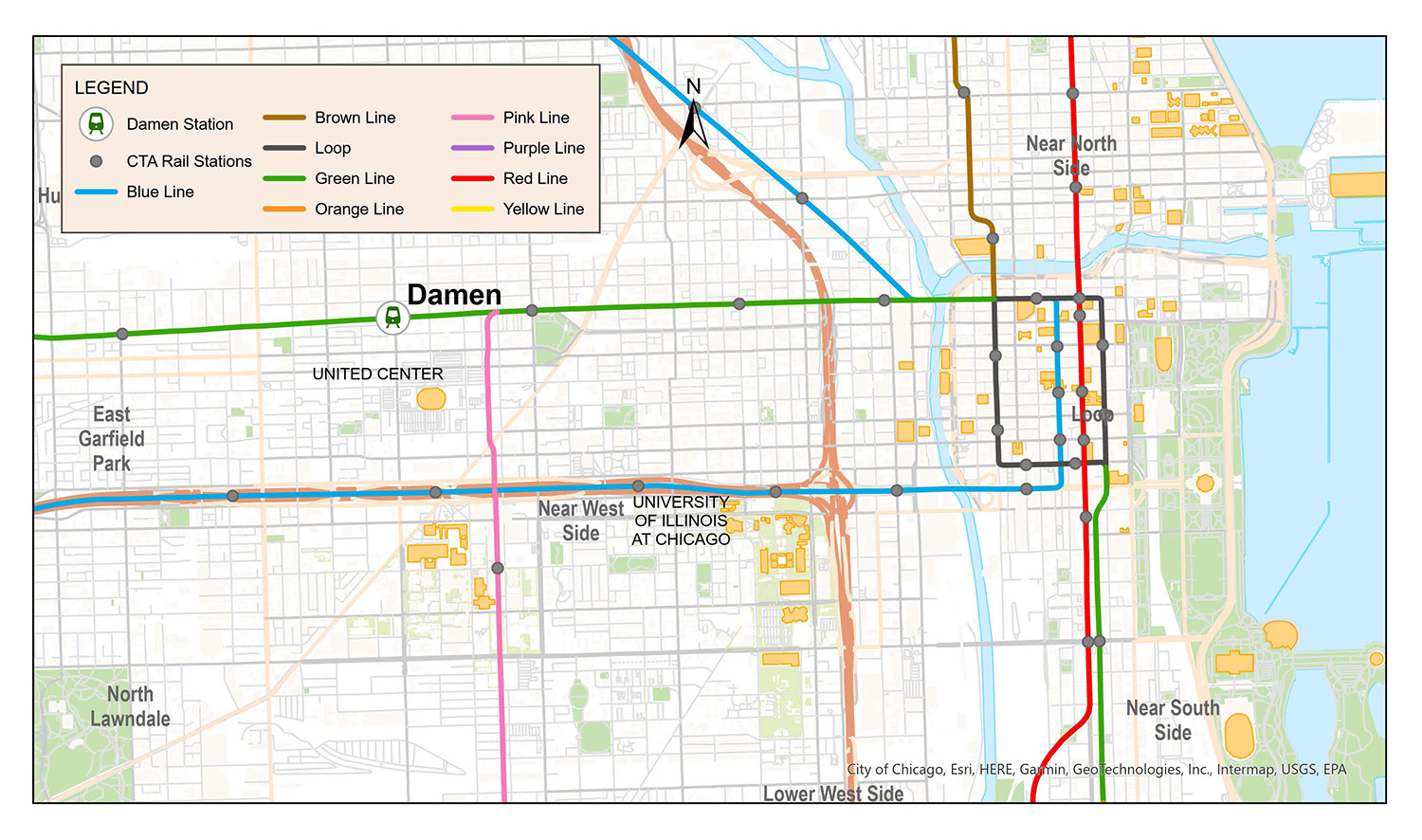
Map showing the location of the Green Line station at Damen Avenue and Lake Street in Chicago. Courtesy of Alexandra Rosander/Chicago Transit Authority.
Built for Surge Crowds
The station was completed shortly before the 2024 Democratic National Convention was held at the United Center — the 20,000-seat arena four blocks south. In the year that followed, the station averaged about 1,000 daily riders during weekdays and between 550 and 750 daily riders on weekends.
"Overall, that is somewhere in the middle of the pack," Kasal says. "But, with infill stations and the development we see around them in the years after they open, it is almost universally true that we open the station, and the ridership continues to tick upward."
The Damen and Lake station is also unique in that it was built to handle a bigger capacity due to its proximity to the arena. "Most stations, it's a trickle of ridership," Kasal says. "Even at rush hour, it's a steady flow. But there, once the lights are out at the Beyonce show, everyone is going home."
Kasal says ridership can surge to 300 to 600 people in just a half-hour after an event at the arena. But others can be much more. He says when a Charli xcx concert ended in fall 2024, the station spiked to more than 1,000 riders in the half-hour after. "That's more than an entire day at that station, typically," Kasal says, "so it's very cool that we built that capacity into that station, and that it can handle those larger crowds."
And while the station opens new ways for the rest of the city to get to the west side to go to the United Center or nearby restaurants or businesses, it also gives the neighborhood's residents an easier path to head east toward the medical district or to the rest of the downtown. "It's really trying to bring all those parts of the community together and creating a fundamental asset that people who live near it will have incredible access to," Kasal says, "and hopefully it will give them an option that might improve their lives for the better."
Infill Still Top of Mind
Since 2023, CCDOTH has been assessing infill opportunities in the city and county through a consultant-led study, says Ryan Ruehle, lead planner for CCDOTH.
"Equity considerations were infused in both quantitative and qualitative analyses," Ruehle says. "For example, the transit propensity scoring incorporated demographics such as zero-car households, low-income populations, and people with disabilities, in addition to more typical metrics such as population and employment. Additionally, sites with high concentrations of these metrics were weighted to ensure areas of highest need would rank favorably. On the qualitative side, we kept a keen eye on geographic equity, ensuring that all regions of Cook County contain recommended sites."
The findings of the study are anticipated to be released this summer. "We hope it can be useful as a catalyst for commissioning Phase 1 design engineering studies for priority sites," Ruehle says.
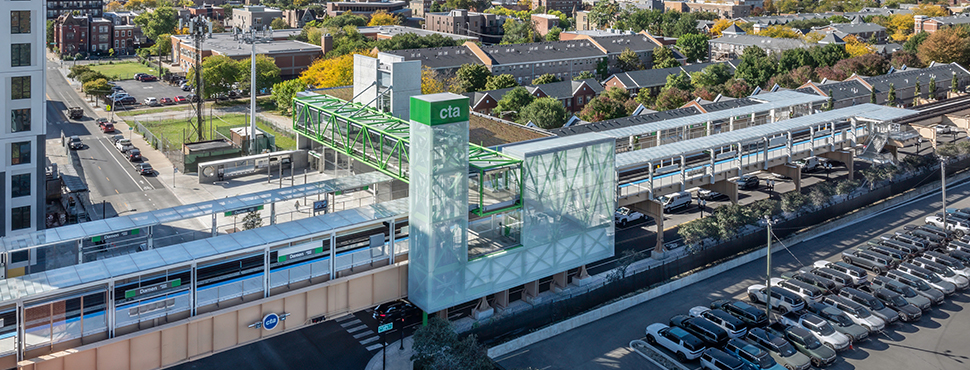
Top image: After 75 years, the Green Line station at Damen Avenue and Lake Street in Chicago was reopened. Photo courtesy of James Steinkamp Photography.
ABOUT THE AUTHOR