


Sponsored Content
No Place to Stop: What Truck Data Reveals About the Parking Gap

On any given Tuesday night, dozens of 80,000-pound trucks are parked on North Carolina highway ramps, heightening risk for their drivers and others. New freight-specific telematics data (GPS and sensor data collected from commercial vehicles) can now put numbers to a problem that planners have long sensed but rarely quantified.
A Pass-through State's Parking Problem
On any given Tuesday night, dozens of 80,000-pound trucks are parked on North Carolina highway ramps, heightening risk for their drivers and others. New freight-specific telematics data (GPS and sensor data collected from commercial vehicles) can now put numbers to a problem that planners have long sensed but rarely quantified.
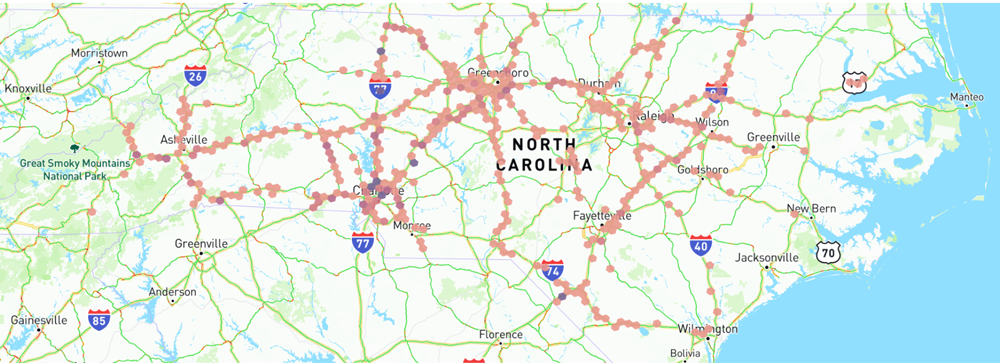
Figure 1: Highlighted areas show long-duration (9-12 hours) heavy-duty truck parking events taking place on North Carolina highway on/off ramps from November 1, 2024, to October 31, 2025.
Three Takeaways for Practitioners
Traditional traffic counts show truck volume, but telematics show behavior
The difference is critical — a ramp parking event isn't just a data point; it's evidence of a gap between where a driver needed to stop and where they were permitted to. This reframes the planning question from "How much truck traffic is there?" to "Where exactly is the system failing, and when?" Pinpointing the problem leads to effective solutions.
1. Plan by corridor, not by area
The data is clear: Ramp parking doesn't distribute evenly across geographies; it clusters along specific high-volume freight corridors. For NC planners, that means I-85 through the Piedmont and I-95 in the east deserve disproportionate attention.
Altitude's parking report offers a useful threshold for prioritization: Corridors registering 5,000 or more annual ramp parking events — roughly 14 or more per day — represent sufficient unmet demand to justify new facility investment. Equally important is where along those corridors capacity is needed. Because the median driver parks after 520 miles and 9.7 hours of driving, planners can work backward from major freight origins to identify where NC-bound drivers are likely to hit that threshold and whether authorized parking exists at those points. Where it doesn't, that's the intervention site.
2. Design for overnight
Peak ramp parking begins between 8–10 pm and clears between 5–8 am. That pattern has a direct implication for how NC planners and developers should evaluate new or expanded facilities because overnight throughput capacity matters more than daytime amenities.
The report also flags that Tuesday and Wednesday see the highest ramp parking rates nationally, reflecting mid-week freight delivery cycles when schedule pressure is tightest. A facility that can reliably absorb overnight demand on a Tuesday in the I-85 corridor is solving the actual problem. One optimized for daytime convenience is not.
This data can help planners evaluate how reserved parking programs could complement public capacity investment, since drivers facing hard HOS deadlines may pay for guaranteed availability.
3. Treat parking as a safety and infrastructure investment, not an amenity
Framing matters enormously for how parking projects compete for funding. The report documents that in the past five years, several hundred people have been killed and thousands more injured in collisions involving trucks parked on ramps and highway shoulders. Heavy truck collisions with injuries carry an average social cost of $195,000 per incident, according to the Federal Motor Carrier Safety Administration.
Beyond crash costs, 80,000-pound vehicles parked on ramp infrastructure — which was never designed for stationary long-duration loads — accelerate pavement deterioration in ways that compound the highway system's existing $684 billion repair backlog. For NC DOT and MPOs pursuing grants from Infrastructure for Rebuilding America (INFRA), Infrastructure Investment and Job Acts (IIJA), or Safe Streets and Roads 4 All (SS4A), reframing parking capacity as a safety and maintenance cost-reduction investment — backed by corridor-specific ramp parking frequency data — is a materially stronger funding argument than treating it as a driver convenience issue.
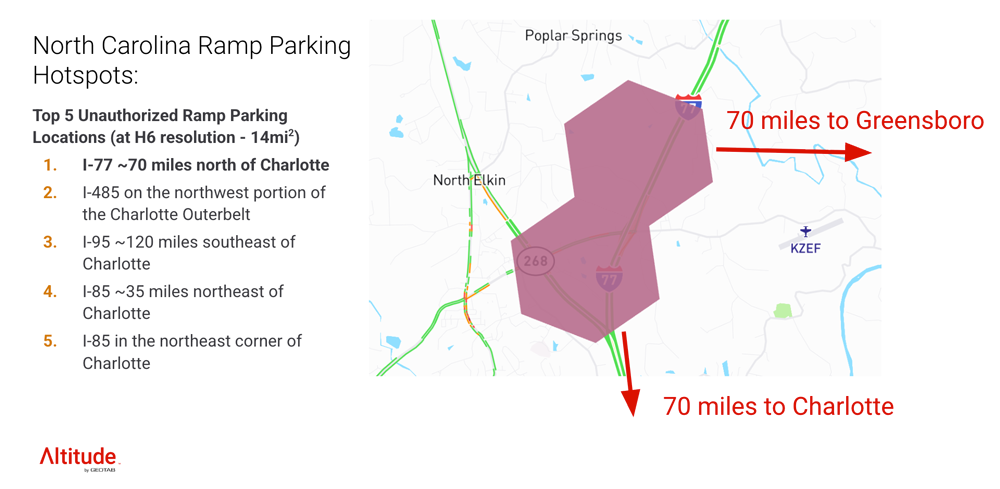
Figure 2: North Carolina's top ramp-parking location lies on I-77, about 70 miles north of Charlotte.
From Problem to Plan
Planners now have the data to move from recognizing the truck parking problem to targeting solutions. The NC analysis shows that corridors can be identified, demand can be documented, and federal funding mechanisms exist to solve the problem. The next step is treating ramp parking frequency as a standard input in long-range freight plans and corridor studies in the same way VMT and level-of-service already are.
To see the full nationwide dataset, including corridor-level ramp parking frequency by state and by metro region, download the full report.
Top Image: Photo by iStock / Getty Images Plus / Alexander Lyakhovskiy
About the Sponsor: Geotab

Altitude by Geotab is a leading provider of advanced mobility insights and solutions for public and commercial sectors across North America. Headquartered in Oakville, Ontario, the company leverages its expertise in data analytics to help decision-makers gain a comprehensive understanding of road network movements. By delivering reliable and contextualized insights, it enables improved planning capabilities and better financial outcomes, while maintaining data confidentiality and privacy. Our solutions drive safer, more efficient, and more sustainable mobility throughout North America. Learn more at altitude.geotab.com and follow us on LinkedIn
About the Author