
Here's How FEMA Could Change — and Why It Matters

summary
- FEMA's proposed reforms would shift more disaster responsibility to states and local governments, raising the stakes for local planning and preparedness.
- Land use, housing, and mitigation planning would play a much larger role in how communities manage risk and recover from disasters.
- Without stronger funding and capacity support, these changes could deepen challenges, especially in smaller and under-resourced communities.
An overhaul of federal disaster management is on the table, putting local planning and land use at the center.
After months of deliberation, review, and public input, the President's Council to Assess the Federal Emergency Management Agency (FEMA) released its final report. It proposes a range of recommendations that could fundamentally restructure the way the federal government supports disaster preparedness, response, recovery, and mitigation.
The council's guiding doctrine is direct:
Disaster response should be locally executed, state or tribe-managed, and federally supported.
To this end, the report recommends expanding the roles and responsibilities of local governments in disaster readiness, recovery, and long-term risk reduction. An overriding focus on land use could place planners even more squarely within the mitigation planning framework than they are today.
However, it is extremely uncertain how a broader devolution of mitigation planning responsibilities away from the federal government may play out in practice, especially if new roles for state and local governments aren't coupled with funding, sustaining, and capacity-building. Additionally, the report itself is largely advisory, and implementing its recommendations will require congressional action. This may increase uncertainties for local planners and communities in the near term.
Five Things for Planners To Know
Here are five things planners should know about the report as they navigate these uncertainties.
1. A Higher Threshold for Federal Help
The report recommends raising the per capita indicator used to evaluate disaster declarations from $1.94 to $2.99, adjusting for inflation between 1986 and 1999. Essentially, this would raise the threshold for determining if a disaster qualifies for federal assistance. The council's analysis found that if this threshold had been in place, 29 percent of disasters declared between 2012 and 2025 would not have qualified for federal assistance. This equates to about 16 fewer federal declarations per year, representing about $113 million in annual federal spending that states and localities would have absorbed instead.
New annual minimum expenditure requirements for states would add another layer: communities would need to demonstrate the ability to contribute funds before federal assistance is considered.
These changes increase the likelihood that a larger share of communities would need to rely solely on local and state resources following a disaster. At a time when climate change is leading to more frequent and severe hazard impacts, this could be especially challenging. In this scenario, pre-disaster planning, fiscal preparedness, and local investments in mitigation are likely to become more consequential than ever.
2. Land Use as a Risk Management Tool
The report's recommendations on the National Flood Insurance Program (NFIP) position local land-use planning as a primary mechanism for managing flood risk. Communities would be expected to adopt stronger land-use policies aligned with modernized, property-level flood risk data. The Community Rating System would be updated to reward communities that integrate resilience activities at the property level. And, as the NFIP transitions toward risk-based pricing and greater private-market participation, local development decisions will have increasingly direct consequences for residents' insurance costs.
Beyond changes to the NFIP, the proposed Refined Risk Reduction Program (R3P), which would replace the Hazard Mitigation Grant Program, directs early post-disaster funding toward residential mitigation — elevation, seismic and wind retrofits, defensible space, floodproofing — and targets repetitive-loss properties and critical infrastructure. Additionally, states would be required to maintain inventories of high-risk properties not built to modern codes.
For planners, this could be a welcome change. Comprehensive plans, zoning codes, building standards, and capital improvement programs have long been recognized as key elements in effective long-term mitigation. The council report identifies these land-use tools as central to more cost-effective resilience and risk reduction.
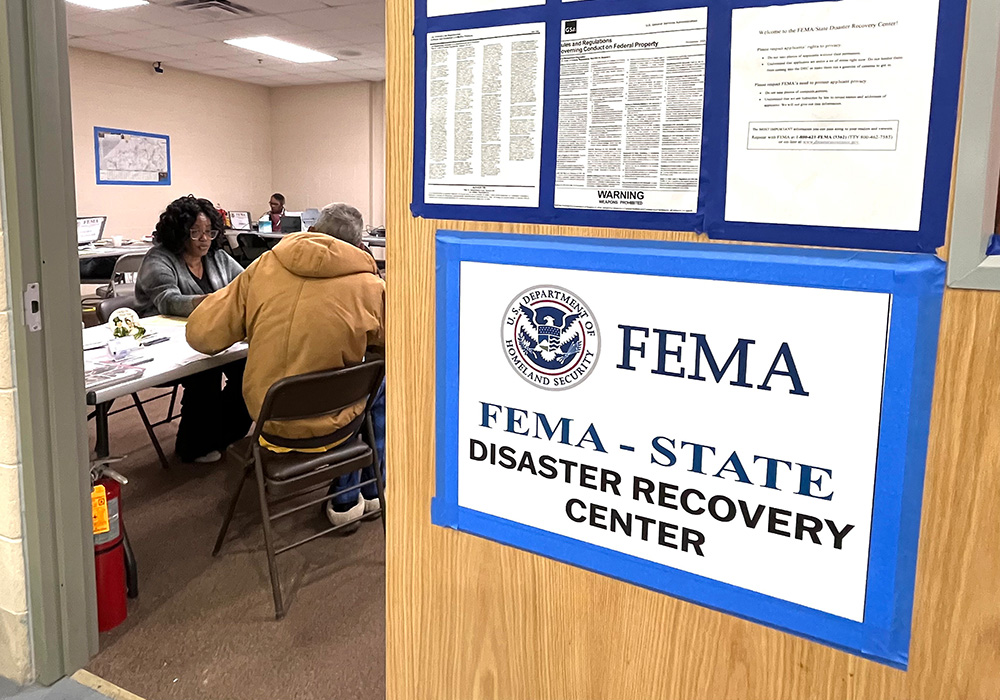
Following federally declared disasters, FEMA plays a major role in standing up state-run disaster recovery centers. Photo by Patsy Lynch/FEMA
3. Housing as a Local Responsibility
Under the proposed Framework for Accessible Individual Relief (FAIR) program, evacuation and emergency sheltering would shift from FEMA to state and local governments. Local governments would be expected to complete initial damage assessments within 30 days of a disaster and "create market conditions that ensure affordable rental properties are available and accessible to survivors."
This puts housing planners, zoning administrators, and community development staff in more prominent disaster recovery roles. Communities that haven't pre-identified shelter sites, planned for temporary housing, or built zoning flexibility for post-disaster housing solutions (modular units, accessory dwelling units, temporary use permits) may find themselves making those decisions under pressure — and on a compressed timeline.
4. Funding Flows Through States
Two of the report's largest proposed programs — the Reformed and Partnered Initiative for Disasters (RAPID), which would replace Public Assistance, and FAIR, which would replace Individual Assistance — route federal funding to states rather than directly to local governments. States would determine project eligibility, manage procurement, and conduct environmental reviews.
For local governments accustomed to a direct relationship with FEMA for infrastructure recovery funding, this is a significant change. Recovery outcomes would depend in part on the quality of the state-local relationship, the state's capacity to administer these funds, and on localities' abilities to advocate effectively within state systems for their share of resources.
5. The Limits of Capacity-Building
Capacity building is central to concerns around local governments assuming increasing mitigation, response, and recovery responsibilities. The council's survey confirmed this: respondents consistently cited staffing gaps, limited technical expertise, and heavy dependence on federal funding to support local actions. The report calls on FEMA to train local practitioners and provide three-year grants for funding local staff. However, this leaves local governments on the hook to find long-term funding for those positions.
For smaller, rural, or under-resourced communities, this raises a fundamental question: How do you lead disaster resilience locally when you lack the staff, infrastructure, expertise, and fiscal capacity to do so? If the report's recommendations are fully realized, this perpetual dilemma could lead to poor outcomes, especially in the event of a natural disaster.
Where Planners Come In
Across these recommendations, local planners are implicated in nearly every domain:
- Hazard mitigation planning: Updating plans to reflect current multihazard risk data and ensuring projects are implementation-ready when post-disaster funding windows open.
- Land-use regulation: Aligning zoning, subdivision, and building code standards with risk-based frameworks that now carry direct insurance and fiscal consequences.
- Housing policy: Pre-identifying shelter and temporary housing sites, maintaining housing vulnerability assessments, and ensuring that zoning accommodates post-disaster housing needs.
- Capital improvement programming: Integrating hazard exposure into infrastructure investment decisions and making the case for resilience to elected officials who make fiscal decisions.
- Cross-sector coordination: Convening local government departments, utilities, nonprofits, faith-based organizations, and private-sector partners around shared preparedness goals before a disaster forces improvisation.
The FEMA review council's report consistently elevates local planning from a supporting function to a central pillar of national disaster resilience. This recognizes the pivotal role that long-term community planning has in reducing risk and mitigating the impacts of natural disasters. However, without deliberate investments in local planning capacity, equitable state funding distributions, and transitional support for under-resourced jurisdictions, these reforms risk widening the gap between communities that can absorb greater responsibility and those that cannot.
The uncertainties surrounding FEMA may take years to resolve, as the Trump administration and Congress determine whether and how to implement the report's recommendations. One thing, however, is clear: going forward, planners and local governments must be prepared to take on larger roles in the framework of disaster response, recovery, and mitigation.
Top image: Disaster Survivor Assistance Teams and Federal Emergency Management Agency (FEMA) Corps members conduct outreach to provide local and FEMA resources to community members in Lake County, Florida. FEMA Photo by Daniel M. Young/Released
About the Author