
The Art of Listening: How Creativity Helped Shape Petaluma River Park
Summary
- Poets to Parkmakers, an arts-based community engagement effort, helped inform and design a 35-acre riverfront park in Petaluma, California.
- The process — which incorporated poetry, visual art, storytelling, and music — prioritized trust-building and inclusion to center voices often left out of traditional planning methods.
- The insights from about 5,000 people directly shaped park priorities, including inclusive design features, youth recreation spaces, and family amenities.
What if planning started with a poem instead of a survey?
In Petaluma, California, that question became the foundation for Poets to Parkmakers, an arts-based planning initiative rethinking how the community could shape a public space. The initiative, led by the Petaluma River Park Foundation in partnership with Kimzin Creative and CMG Landscape Architecture, undertook a two-year community engagement process to create a concept plan for a 35-acre riverfront park. More than 5,000 residents participated.
Some planning processes treat art as outreach or decoration, but Poets to Parkmakers saw it as infrastructure. "We wanted to use art as data, design, and — most importantly — communication," says Nikko Kimzin, founder and lead consultant at Kimzin Creative.
Art as a Planning Method
Seair Lorentz, executive director of the Petaluma River Park Foundation, says the foundation met with local nonprofits and community organizations early on to find out who had historically been excluded from planning conversations. They recognized that public meetings and surveys alone were unlikely to capture those experiences.
"[But if you] design for the margins, you design for everything in between," Lorentz says. "Our mission is to connect people, art, and nature in a shared space. So, while we are a park, we're [also] something beyond [that] — we're not just trails, open space, and a playground. We have this cultural programmatic element, and art is really key to that."
The foundation hired Kimzin Creative to lead the art-based community engagement events. The goal was to transform traditional urban planning methods into a "joyous container" for community co-creation, says Kimzin. Rather than using standard surveys, the team wanted to tap into the power of art to unlock residents' creative potential and ensure the park reflected their values and needs.
One of the first events was a poetry session led by Kayatta, a local queer woman of color and hip-hop artist. The session was designed to center Black and LGBTQIA+ youth voices and to create space for them to define what safety in public spaces means to them. Lorentz says those insights informed design considerations to focus on visibility, inclusive symbols such as pride flags, and maintaining clean, well-lit, and accessible trails.
This event was co-sponsored with Amor Para Todos, an organization dedicated to serving Petaluma and Sonoma County's LGBTQIA+ community. "It was beautiful to see our diverse local queer community in one room: people from ages 18 to 70s, people of different ethnicities, skin colors, cultures, physical abilities, socioeconomic statuses, genders, and sexual orientations," says Emelina Minero, an Amor Para Todos board member. "Three languages were spoken that night, and an interpreter made it possible for a mom to share that what she wanted most for her daughter was to feel a part of a community. Her daughter shared with me she was grateful for that workshop — she was in a place where she felt she belonged."
Additionally, Kimzin Creative distributed its bilingual coloring workbook, My Dream Park, to more than 500 students, asking them to imagine and illustrate their ideal parks. The exercise revealed a strong desire for community spaces designed for younger residents, like clean, accessible restrooms and picnic areas for families.
How Art Revealed What Traditional Tools Missed
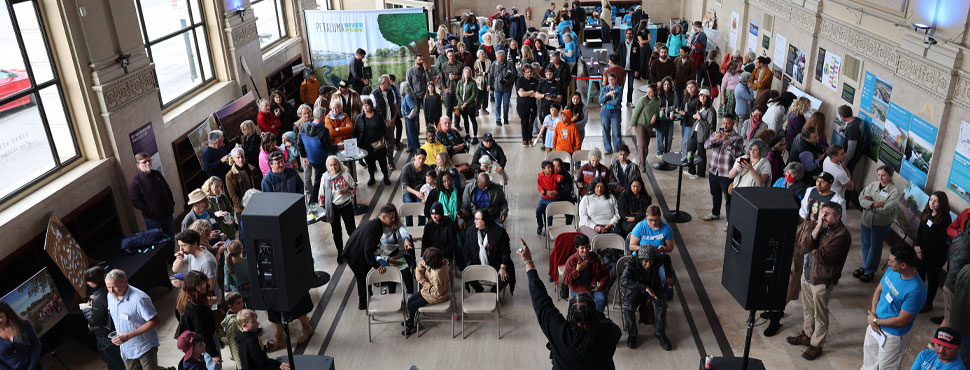
Poets to Parkmakers also reimagined how feedback was returned to the public. Rather than producing traditional reports summarizing community input, the team used "share back" events. In some cases, artists translated workshop conversations into original spoken-word and musical performances, which they then presented to participants at community gatherings. This was the case when Kayatta sang songs and read poems developed from what was shared at previous engagement sessions during the Dreamscapes Concert and Plan Reveal.
"No one is better at meeting the community where it is at than artists," says Lorentz. "They have this innate ability to get into a relationship with people and to articulate and express things that people can't even articulate themselves."
Beyond community engagement events, the team wanted to ensure the residents' voices remained central throughout the planning process. Fifteen local leaders were nominated from within their neighborhoods to review the feedback gathered throughout the sessions.
And while traditional methods may have ultimately identified some of the same priorities, the Poets to Parkmakers process allowed for a deeper level of insight. The team gathered personal stories, individual experiences, and nuanced perspectives that helped inform specific design decisions. One example came when Kimzin was approached by a young resident who said he just wanted a basketball court at the future park. Later, when the design team shared plans that included a court, the young man was surprised to see his idea reflected in the project.
"I told him, 'Wasn't that what you said?'" Kimzin recalls. "And he’s like, 'Yeah, but I didn't think you would actually do it.' That is a cool moment where we get to come back to the community and say, 'Yeah, we heard you.'"
Petaluma's Future
With the concept plan completed and approved by the Petaluma River Park Foundation in early 2025, Poets to Parkmakers has shifted to the next phase, which includes design and engineering for the park's playground, bathrooms, and flex fields. Construction is expected to begin in 2028.
But even before shovels go into the ground, the site is already being used. The Petaluma River Park Foundation has continued to activate the site with programming such as Zumba classes, local markets, and more. These activities allow residents to use the space while helping project leaders test ideas, build community connections, and continue shaping the park's future.
"The park already exists in many ways," says Lorentz. "Our job now is to build on that foundation, not replace it."
Top image: Insights from the Poets to Parkmakers community engagement sessions were shared with the public in creative ways, including the Dreamscape Concert and Concept Plan Reveal. Photo by Petaluma River Park Foundation.
ABOUT THE AUTHOR