


Uncovering JAPA
Three Lessons from California's ADU Efforts

summary
- California's ADU reforms succeeded after the state removed local barriers, sparking new housing development and a market of services to support homeowners and builders.
- Owner-occupancy requirements limited SB9's impact by placing complex financing, subdivision, and construction challenges on individual homeowners.
- San Diego's Bonus ADU program expanded the role of small developers, enabling larger infill housing projects in single-family neighborhoods.
Accessory dwelling units (ADUs) are often embraced as a form of gentle densification. Homeowners can stay in their homes while building an additional unit in the backyard for family members or supplemental income. This core ideal of homeowners being the change agents in neighborhood densification is apparent in many ADU reforms that require owner occupancy and exclude developers from projects.
In "Legislating Gentle Density From Above? Learning From the Divergent Outcomes of Three Small-Lot Densification Modes in California" (Journal of the American Planning Association, Vol. 92, No. 2), Jake Wegmann, Karen Chapple, and Andrew Wofford examine the details of state and local ADU reforms. Their study explores how state and local laws were limited by owner occupancy rules and how one city bypassed the standard altogether.
Synthesizing Reform
ADU development eventually succeeded because the state repeatedly toppled local regulatory barriers. Once the legal breakthrough happened, business innovation began. Firms formed and adapted to provide design, construction, financing, and other services to help homeowners realize ADU projects.
While attempting to extend successful ADU reforms, California HOME ACT (SB9) fell short because of a mismatch between the homeowner as the ideal change agent and the complexity and scope of an SB9 project. The authors argue that small developers are much better positioned to divide lots and add units. The owner occupancy requirement blocked their involvement.
To identify factors that allow for ADU deregulation and bonus ADUs, the authors look at three efforts in California.
- Statewide deregulation of ADUs (2017-2022)
- Legislation facilitating lot splitting (2022)
- San Diego's Bonus ADU program (2020)
The study relies on a dozen key informant interviews, a survey of municipalities, the economic analysis of prototypical housing developments, and geospatial analysis. The authors determined how statewide reforms were received by local governments by assessing subsequent city ordinances.
A survey administered to all 540 California cities and counties led into follow-up interviews about perceptions among the general public and elected officials about statewide ADU legislation. Additional interviews with developers, city and state officials, lenders, housing finance consultants, and middle housing advocates contributed to the authors' understanding of changing barriers to small-lot development.
ADUs in Context
The ADU is generally understood as a smaller, subordinate house that shares a property with a single-family house. Early proponents of ADUs emphasized their value to homeowners navigating life changes. Accompanying the rapid growth of national interest in ADUs, the arguments in favor have expanded to include claims of social equity, environmentalism, and financial efficiency. This movement was a direct counter to the zoning "straitjacket" of R1, or single-family zoning, the widespread designation that excludes all other kinds of development except for single-family homes. The ADU movement is not alone in its critiques and creativity.
Incremental ADU Reform
In 1982, California's Senate Bill 1534 (SB1534) made it legal to build ADUs. In 2003, the state passed another law, this time pressuring local governments to approve ADUs. Yet, little new development resulted. Local governments enacted next-to-impossible standards for ADUs, nulling the state-level encouragement. It took a suite of legislation between 2017–2022 to override local obstacles and spur ADU production. This recent series of laws is the subject of the authors' comparison.
| Year | Changes Made Through Legislation |
|---|---|
| 2017 |
|
| 2019 |
|
| 2020 |
|
| 2021 |
|
| 2022 |
|
ADUs on the Rise
California's new ADU laws prompted an entirely new housing submarket. More than 28,000 ADUs were permitted in 2023, up from 1,000 in 2016. Permitted ADUs went from virtually nonexistent to making up almost 15 percent of all permitted units statewide during that interval.
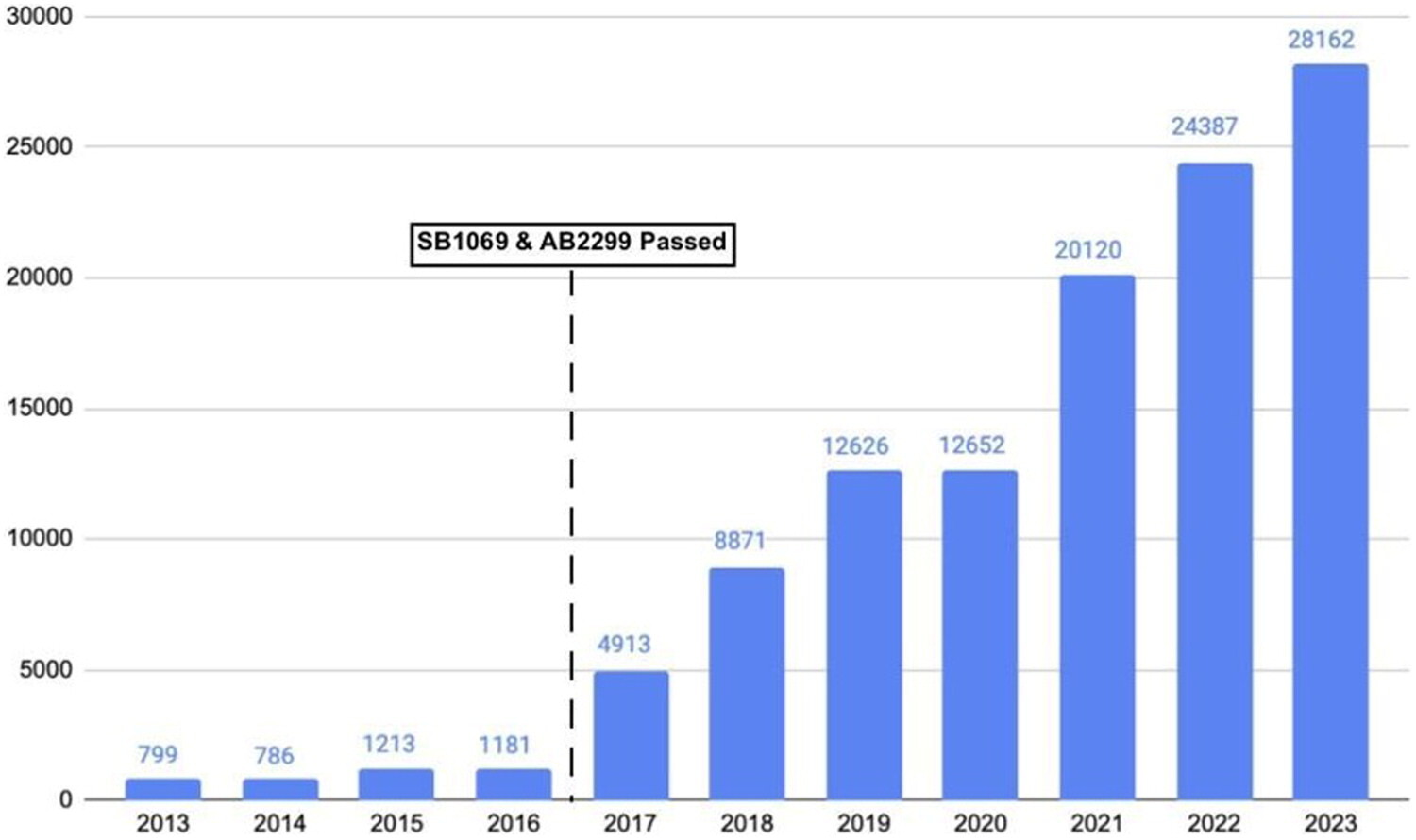
Figure 1: California statewide permitted ADUs by year, 2013-2022. (Credit: The California Department of Housing and Community Development and Bipartisan Policy Center.)
The authors' review of local ordinances revealed that more than half of California's jurisdictions placed barriers in the way of ADU construction after early state legislation. These ranged from extra fees for utility connections and address recording to restrictive setback regulations and parking requirements. Subsequent state laws overrode much of this pushback. Now, despite some opposition, many local governments are encouraging and supporting ADU construction through economic incentives, streamlined approval processes, access to information, technical assistance, and pilot programs focused on affordability.
ADU reform legislation is broadly popular. Of the surveyed jurisdictions, 86 percent indicated that both the general public and elected officials were "supportive" or "very supportive" of the new ADU legislation. The enthusiasm is not without nuance. Most jurisdictions struggle to interpret or implement the top-down legislation.
Subdividing By Right
In 2022, SB9 went into effect. This law allowed single-family homeowners to divide their parcels into two, each of which can then have two housing units. SB9 was specifically designed to produce reasonably priced homeownership options. This was in direct contrast to ADUs, which typically cannot be sold off. The state law offered options for duplexes and ADUs. New-build dwellings must meet local design and zoning requirements, unless those requirements make it impossible to add two units of 800 square feet on each lot.
Obstacles to Implementation
While SB9 was celebrated for eradicating R1 (single-family) zoning across the state and clearing the way for missing middle housing, it has fallen short of its promises. Two years after SB9's passage, only 266 projects had been permitted or completed in California.
The authors identify the owner occupancy requirement as a major obstacle to the law's effectiveness. It is a heavy lift for homeowners to manage the costs and headaches of lot splitting and building as many as three more units all while living amid an intensive construction project.
Mortgages are an unanticipated obstacle to homeowners making use of SB9. Most homeowners owe a significant mortgage principal balance. This means a lot split relies on the loan servicer agreeing to a partial loan release and restructuring the debt around the remaining property and its new, lower appraised value. Servicers often will not approve or even discuss these releases. A remedy would entail Fannie Mae and Freddie Mac developing a new purchase mortgage standard that allows for a future lot split.
Local constraints also stand in the way of SB9 development. While the state law prevented localities from using zoning, subdivision, or design review to preclude the additional units, it did not specify how this standard would be enforced. As a result, many local governments implemented policies likely flouting state law. Front setback requirements are one example of local disregard. Another significant barrier to uptake is development fees, which can reach $50,000.
For SB9 to have a substantial impact, state legislators will need to decide whether to update and improve the law incrementally, as they did with ADU laws, or start fresh. To build support for further lot division reform, lawmakers must balance three conflicting priorities from the bill's initial compromise: maximizing missing middle housing production, minimizing disruptions to existing residents, and preserving local control.
A New Housing Type
San Diego's 2020 ADU Density Bonus program allowed property owners, not just homeowners, to build bonus ADUs beyond the two allowed under state law. The program offered even greater allowances to properties inside a transit priority area (within a half-mile of a major transit stop), which makes up the central swath of San Diego. In this area, unlimited bonus ADUs are permitted. This permissiveness expands the concept of the ADU beyond a single garage unit or granny flat into an entirely new housing type.
Tenant income restrictions are woven throughout the program's increased allowances. Each new bonus unit with market rents must be paired with an income-restricted, affordable unit. The latter must rent to tenants earning no more than 110 percent of the area median income (AMI) for 15 years or 80 percent of AMI for 10 years. A property that will add more than nine new ADUs must designate one of them as affordable at 50 percent of AMI or else pay an in-lieu fee. The city's housing commission handles initial and recurring income verification.
R1 Neighborhoods with Multifamily Rentals
San Diego's program unlocked small-lot multifamily apartment buildings, derisively called granny towers. The city's program relinquished the ideal of homeowner occupancy and involvement in ADU construction. Better suited to these complex projects with long-term calculations, small developers jumped on the opportunity to densify R1 neighborhoods. San Diego now sees developers buying existing single-family homes and duplexes on suitable lots and adding large numbers of units. Developers tend to hold onto the multifamily properties for the long term rather than selling after construction.
The program went into effect at the beginning of 2021. In the three years following, almost 1,300 units were proposed. The Bonus ADU program led to numerous multifamily projects that were unusually large for their residential settings, adding 10-38 new units per site.
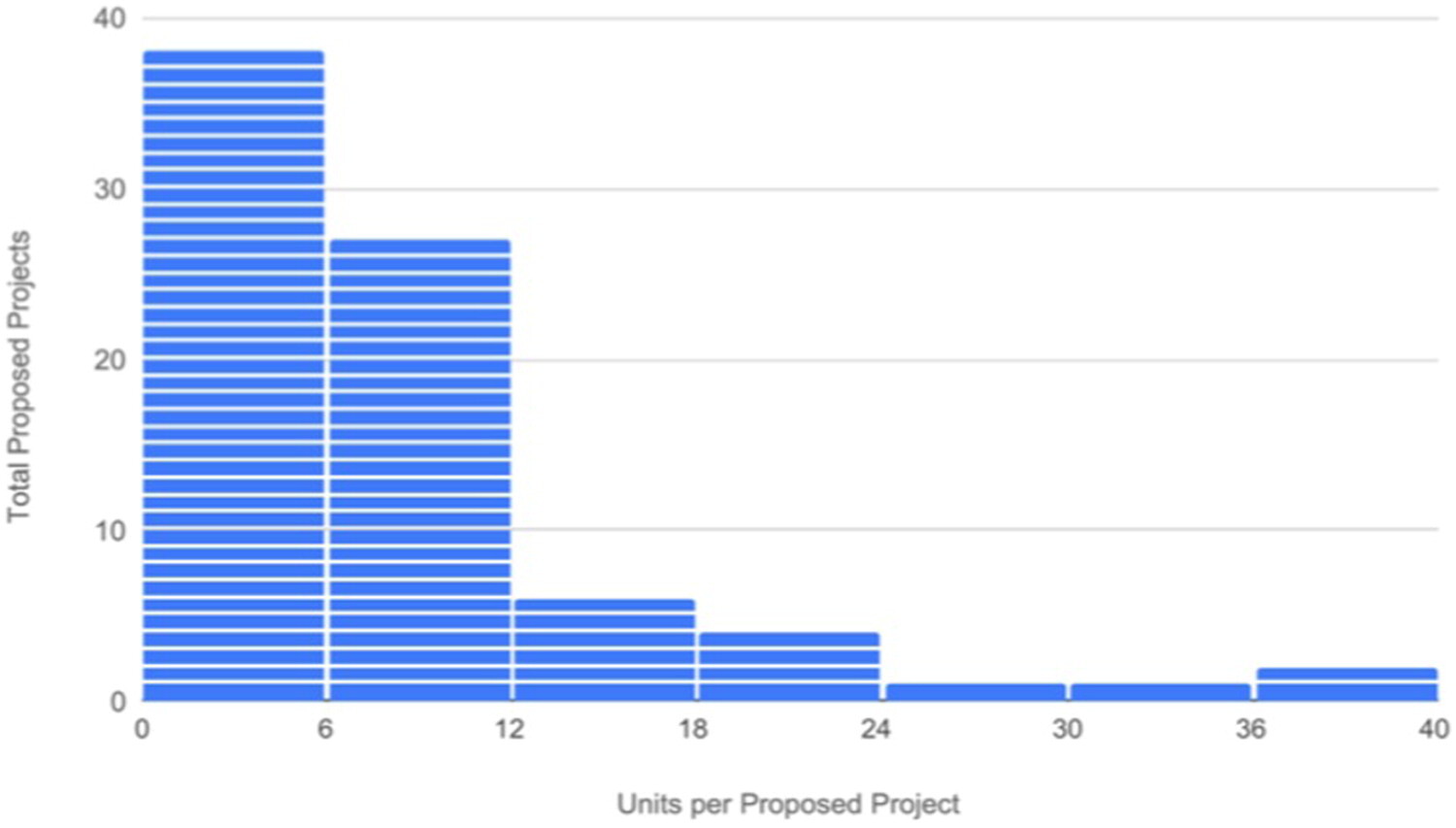
Figure 2: Total proposed bonus ADU developments by number of units. This chart omits one outlier, a 148-unit proposed project, to maintain readability. (Credit: Authors, internal data provided by San Diego Housing Commission).
In a case study of financial feasibility, the authors found that bonus ADU developers can yield significant densities on infill sites. With floor-area ratio limits as their only constraint, developers can turn attractive profits on these projects. In interviews, developers emphasized the high costs of upgrading electrical, water, and sewer connections. Costs can reach $150,000, likely turning away smaller-scale developers and community-based nonprofits from the bonus ADU program. That high price tag is compounded by the cost of project managers with expertise interacting with utilities on complex projects.
The program has failed to deliver many low-income units. So far, every developer making use of the bonus program has opted to restrict affordable units to 110 percent of AMI, rather than 80 percent of AMI.
Grafting its initiative onto statewide ADU laws, San Diego opened a procedural back door to small-lot redevelopment. The city's program pushed the conceptual boundaries of ADUs, raising new questions about pathways to densification.
Key Takeaways
- For ADU development to occur, the state repeatedly toppled local regulatory barriers.
- ADU business innovation quickly followed the legal breakthrough.
- Owner-occupants are often not equipped to deal with complex subdivisions and multifamily development.
- San Diego's bonus ADU program piggybacked on state ADU reform law, but abandoned owner-occupant standards.
- San Diego small developers brought multifamily development into R1 neighborhoods.
Top image: Photo by iStock/Getty Images Plus/ IMG visuals characters