


Spotlight on Zoning Practice
Check In on Short-Term Rental Regulations Before Long-Term Residents Check Out

Summary
- Short-term rentals remain popular options for tourists, requiring planners to consider regulations that appropriately balance short-term rentals and neighborhood stability for long-term residents.
- Regulating the concentration of short-term rentals can reduce impacts on residents that might alter the community character.
- Effectively managing short-term rentals and their compatibility requires a holistic zoning framework.
This summer soccer fans from around the world flocked to the U.S. for the FIFA World Cup. And many of those visitors turned to short-term rental (STR) platforms like Airbnb and Vrbo for their accommodations. Prior to the event, Airbnb pushed host cities to weaken their STR regulations in anticipation of increased demand. While two communities near Kansas City temporarily lifted some restrictions, most host cities held the line. The response from these cities reflects the challenges planners face when developing regulations that balance tourism and the needs of long-term residents.
In the August issue of Zoning Practice, "Balancing Short-Term Rentals: Community Character and Tourism," Alexandra Carter, AICP, discusses the tension between STRs and long-term residents and how planners can address concerns through zoning. So, what have we learned over the past 15 years of zoning experiences?
Concentration Affects Neighborhood Function
Carter explains that, for most communities, the goal is not to exclude all STRs but to prevent an overconcentration of them. When too many STRs operate in a small residential area, it changes the function of the neighborhood. According to Carter, perceptions about neighborhood character depend not only on built form but also the functionality of the area for long-term residents. When STRs are clustered, neighborhoods are more likely to experience increases in resident turnover, reduced continuity in social and economic interactions, and a greater number of nuisance complaints. These effects may alter the daily interactions and social connections of long-term residents.
To deter overconcentration and ensure the preservation of community character, Carter recommends incorporating density controls for STRs into the zoning code. These measures might include limitations on the number of STRs per block, within a building, or within a certain distance from one another. The zoning ordinance should also clearly define and enforce management standards to adequately address nuisance complaints as well as licensing requirements to target noncompliant operations that might contribute to overconcentration. These regulatory measures are most effective as part of a larger zoning framework tied to land use intensity.
A Cohesive Framework Promotes Balance
Communities often struggle to create a comprehensive zoning framework that integrates STR regulations with regulations for other transient lodging uses. When STR regulations are developed independently, there is a risk that these rules will be disconnected from the rules for traditional bed and breakfasts or hotels and, therefore, applied unevenly. This is because the business model of an STR or other transient lodging use is seldom the primary determinant of its land use effects.
According to Carter, a cohesive framework should clearly establish the permissible types and intensities of transient lodging for each functionally distinct subarea of the community. And these permissible types and intensities should reflect both the vision for each subarea as outlined in the local comprehensive plan and the intent statement for each corresponding zoning district. Carter also notes that it may be helpful to group neighborhoods with similar development patterns and functions to create a neighborhood typology, where each type has a different permissible mix of transient lodging uses at different intensities. As Carter explains, though, even the most cohesive framework still requires ongoing monitoring, enforcement, and evaluation to ensure compliance and alignment with community priorities.
Subscribe to Zoning Practice
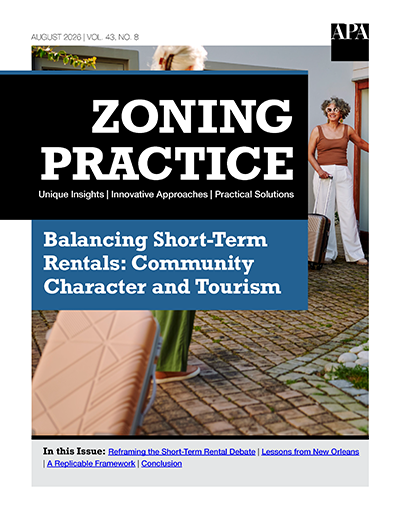
Each issue of Zoning Practice provides practical guidance for planners and land use attorneys engaged in drafting or administering local land use and development regulations. An annual subscription to ZP includes access to the complete archive of previous issues.
Top image: Felix Photographer / iStock / Getty Images Plus