
Planners Can Be the DNA in Creating Successful Infrastructure Projects
summary
- Planners can lead complex infrastructure projects by combining broad expertise, collaboration and strategic decision-making.
- The Discover-Navigate-Accelerate (D-N-A) framework helps teams define project needs, evaluate solutions, overcome obstacles, and move viable plans toward implementation.
- Examples from healthcare, transit and military facilities show how planners can use data, partnerships, flexible thinking, and funding strategies to deliver infrastructure projects.
Planners may not always see themselves as leaders in infrastructure development, but they’re often best equipped to guide these complex projects. “It requires your leadership, and you have it,” said Brian Pieplow, AICP, LEED AP, during a session at the 2026 National Planning Conference (NPC26) in Detroit. “You have the broadest skill set of any professionals working on the project team.”
Pieplow, principal planner at MCFA, has dedicated much of his career to infrastructure planning. He and MCFA co-founder Michael Fuhrman, AICP, LEED AP-ND, established an approach called Discover, Navigate, Accelerate (D-N-A) to help others navigate the challenges that these projects often present.
At NPC26, Fuhrman, Pieplow, and MCFA Associate Planner Hannah Bacso, AICP, shared how planners can guide infrastructure development and apply the D-N-A process to their own work.
What Discover-Navigate-Accelerate Means
Fuhrman and Pieplow developed D-N-A in 2018 and published a book about it six years later. D-N-A has three phases:
- The Discover phase establishes the problems that need to be solved, as well as the project’s goals and risks. Simply put, it’s “what” and “why.”
- The Navigate phase considers any obstacles and alternate choices. At this point, it’s about what’s possible, who benefits or is harmed, and which option is the best solution.
- The Accelerate phase looks at how to fast-track implementation through funding and partnerships.
“The D-N-A process is equally helpful at the outset of a project to define requirements, or to help unstick a project at key milestones, when projects may be stuck or having difficulty due to internal team challenges or external agency challenges,” shared Pieplow in a recent interview with the American Planning Association.
Data in Development
Following the framework helped planners better understand facility needs at the Tibor Rubin VA Medical Center in Long Beach, California.
After learning in a workshop that the medical center relied on scattered, outdated building data, planners developed a comprehensive ArcGIS tool with current, centralized facility information. Rather than use standard surveying processes and data sheets that can quickly become outdated, the D-N-A process enabled planners to create a tool that can be adapted as changes happen, Bacso and Pieplow shared.
“For our client VA hospital — and us, as well — this helped gain insights on what projects need to be funded and then also provided the justification for that project,” Bacso said at NPC26.
When It Comes to Infrastructure, Think Bigger
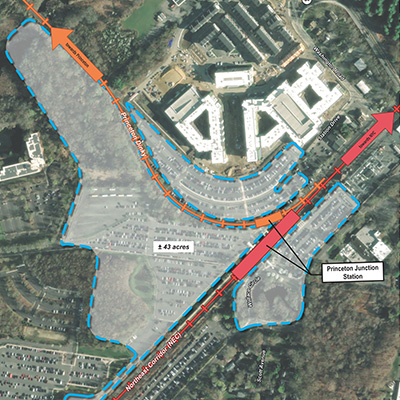 Planners partnered with New Jersey Transit to identify and redevelop underutilized station parking lots and increase the area’s economic viability. Image courtesy of MCFA.
The cliché of less is more doesn’t necessarily apply to infrastructure development. When a project is stalled, “sometimes it makes sense to widen the aperture,” Fuhrman said at NPC26.
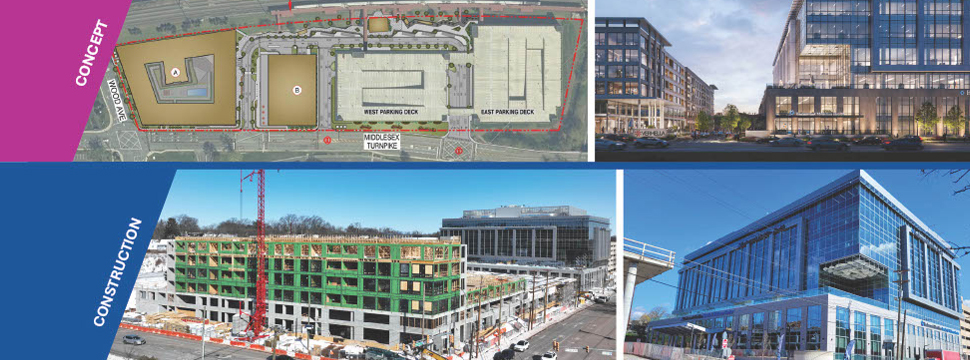
For example, MCFA planners collaborated with New Jersey Transit to identify and redevelop station parking lots that were underutilized after the pandemic. At Metropark in Iselin, New Jersey, planners also worked with the municipality to simultaneously redevelop an adjacent property. This not only expanded the project’s scope but also made the process more efficient and effective, Bacso said.
“Sometimes, it takes one person, one champion, to drive a project forward,” Fuhrman added. “Over three years, this went from being a vacant non-ratable piece of property on the northeast corridor 30 minutes outside of New York City to a half-billion-dollar program medical center.”
When is it OK to Start Over?
At another project for a military complex aviation facility, planners had to rethink an entire plan from start to finish — twice.
Initially, planners received a master plan created by another organization to expand the site. But wetland and environmental issues were apparent. “It was not going to be permittable,” Fuhrman said. “It would never be constructed. It’s OK to say, ‘Hey, are we doing the right plan?’”
After they reimagined the plan for the first time, updated state regulations required a 100-foot wetland buffer. Once again, planners needed to reevaluate their idea, ultimately deciding to raise the site by 7 feet with 240,000 cubic yards of dirt. After five years, the site is fully operational.
“Never be afraid to keep going back to the drawing board, work with the sponsors, work with the partners, and come up with a plan that actually can be built,” Fuhrman said.
Find the Right Funding
Good ideas often slip away without the right financial support. “It took me a long time to learn this,” Fuhrman said. “I had so many great ideas in my 20s. I was brilliant in my 30s — and no one thought so until I figured out how to find the money to get projects built.”
One of the best ways to secure financing is to reach out to a wide range of stakeholders. Planners working on station areas along the proposed 18-mile Glassboro Camden LRT reached out to universities, major employers, hospital systems, city officials and neighborhood groups to increase funding and awareness.
“The larger the net that can be cast to benefit the broadest set of constituents and interests, the better the result for all,” shared Pieplow and Bacso.
Top image: Planners are leading the redevelopment of Metropark in Iselin, New Jersey. Photo courtesy of MCFA.
ABOUT THE AUTHOR