


Practical Digital Detox Strategies for Planners
summary
- Being constantly connected to smartphones and other devices can take a toll on our well-being, contributing to stress, anxiety and burnout.
- Research suggests a "digital detox" can have positive effects on well-being.
- While planners can't unplug entirely, there are practical strategies they can use to build a healthier relationship with technology.
Technology has transformed how planners work. These tools can make planners' work more accessible, searchable and relevant. "We've seen evolutions like data standards, artificial intelligence (AI), interactive applications such as story maps, and integrated workflows," says David Wasserman, AICP, chair of the American Planning Association's (APA) Technology Division.
But like many professionals, planners can feel overwhelmed by being constantly connected through smartphones, laptops and other devices, which can take a toll on well-being. Angela Y. Lee, PhD, an assistant professor at the University of Wisconsin–Madison who studies media psychology and media effects, says research has linked heavy media use with stress, anxiety, depressive symptoms and burnout.
Beyond those effects, technology can also leave people feeling guilty about how they spend their time. Time spent mindlessly scrolling can feel like time that could have gone toward finishing a task, exercising or connecting with family and friends.
Taking a "digital detox" can help. In a recent study on smartphones, participants whose mobile internet was blocked felt less anxious and stressed, were more satisfied with their lives and showed improved attention.
For planners, though, unplugging entirely isn't realistic because technology is embedded in much of their day-to-day work. Instead of a complete digital detox, the goal can be to find small, sustainable ways to build a healthier relationship with technology.
Find What Works for You
There is no one-size-fits-all approach, says Lee. Instead, she recommends experimenting with different strategies, paying attention to what makes you feel better or worse and adjusting your habits accordingly.
Start by identifying the platforms that consistently leave you feeling worse and setting intentional boundaries around them. For some people, that might mean deleting an app entirely. Others may benefit from more flexible limits, such as setting aside specific times to check email or social media.
Lee suggests using an alarm you can hear to signal when that time is up. Rather than relying on a phone notification that's easy to snooze, a physical alarm can pull your attention away from the screen and back to your surroundings.
The larger goal is to create a routine that makes media use more intentional rather than passive.
Pay Attention to What You Consume
It's not only how much time you spend on technology that matters: Lee also recommends paying attention to the content itself. "Think about what type of content makes you feel good versus bad?" she says.
For some, social media might be a valuable way to stay connected with family and friends. For others, the same platform might become stressful when their feed fills with arguments or other content that leaves them drained. If certain content consistently makes you feel worse, Lee suggests "decluttering" your feed by snoozing, muting or blocking it — even temporarily.
Go Touch Grass
Still, with today's technology, it can be difficult to know when you're "done," says Andrea Trabelsi, AICP, a member of APA's Technology Division. There's always more information to find, analysis to consider or feedback to incorporate. Constant connectivity can also blur the boundaries between work and home.
One cue that it's time for a break, Lee says, is when you find yourself mindlessly scrolling.
"At the end of the day, all media is helping us achieve some kind of goal or some need," Lee says, but when your media use is no longer serving a purpose, that's a signal to step away and reset.
It also doesn't have to be complicated. Take a walk, stretch or find another way to reconnect with the physical world. Wasserman describes it as "touching grass," ideally in a way that connects planners with the reason they chose the profession in the first place.
"Every planner across disciplines has something that drives their passion for improving the livability of the communities we serve," he says.
For an urban designer, that might mean spending time in a favorite third place. A transportation planner might go for a bike ride. Whatever the activity, stepping away from the screen can be a reminder that the places, people and communities planners work with exist beyond the digital world.
Remember: The goal isn't to reject technology. Instead, it's to use it intentionally, while making room to reconnect with the places and experiences that give planners' work meaning.
Need a Digital Detox?
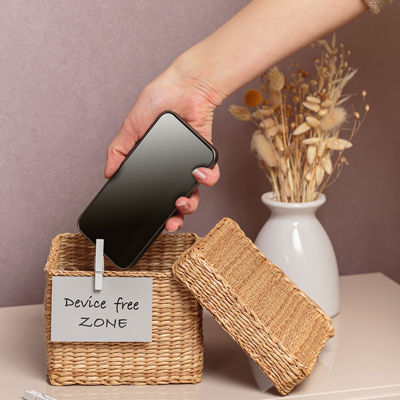
Try these tips:
- Silence notifications and check email or social media at set times.
- Set limits for distracting apps.
- Build short phone-free periods into your day.
- Replace a problematic tech habit with a healthier activity, like a phone-free lunchtime walk.
- Put your phone away during meals and conversations.
- Use screen-time tools to identify and reduce unnecessary use.
- Charge your phone outside the bedroom.
Top image: Thatphichai Yodsri/iStock/Getty Images Plus. Sidebar image: Svittlana/iStock/Getty Images Plus
ABOUT THE AUTHOR