

April 17, 2026
You can see the future of New York City in Douglas Romero's inbox.
Romero is head of construction lending at Ponce Bank, a $3 billion bank based in the Bronx. His inbox is flooded with proposals for projects throughout the city. They mostly come from existing or previous clients, along with a few from new contacts Romero has met around town. They could be for residential, commercial, mixed-use, or community projects or facilities of some kind.
On a typical day, he has time to take a first look at maybe a dozen of them. "I have more deals than I know what to do with," he says.
Romero serves on the bank's loan committee, which has approval power over most of its lending — a portfolio that currently includes $690 million in multifamily housing, $436 million in commercial real estate, and $888 million in construction loans.
Ponce Bank is different in a lot of ways. Founded in 1960, it is the city's only Hispanic-designated minority depository institution and one of only two banks headquartered in the Bronx. It's also a federally certified community development financial institution (CDFI), meaning it does at least 60 percent of its lending in low- and moderate-income areas, or "other targeted groups," such as Black, Hispanic, or women borrowers.
There were more than 15,700 community banks across the country 40 years ago. Today, Ponce Bank is one of only about 3,900 such institutions, all operating in a similar basic fashion: Their ability to underwrite deals relies on their loan committees' proximity to, familiarity with, and networks in the neighborhoods where they lend. "When people tell us the addresses, when people tell us 'this is what we're looking to do and where,' we almost know already [if we'll make the loan] based on what we see," Romero says. "This is what we do all day. We're deal junkies."
Planners are wise to develop a more nuanced understanding of banking and lending institutions, says James Carras, a planner and lecturer in public policy at the Harvard Kennedy School. "Planning decisions shape capital flows, whether planners acknowledge it or not," he says. "Without fluency in finance, planners are often operating with only half the toolkit they need."
Banks are not a monolith
While community banks represent just 11 percent of assets among federally insured banks, they represent 31 percent of commercial real estate mortgages, 32 percent of small business loans, and 33 percent of construction loans. Meanwhile, the largest four banks combined (Chase, Bank of America, Wells Fargo, and Citi) represent 42 percent of assets among federally insured banks, but account for just 11 percent of commercial real estate mortgages, 18 percent of small business loans, and 11 percent of all construction loans among banks.
Those differences have a lot to do with how banks are structured. Broadly speaking, community banks take deposits and make loans in a concentrated geographic area. As described by the Federal Deposit Insurance Corporation (FDIC), community banks "are best known for their emphasis on 'relationship lending,' where bankers leverage their deep knowledge of the local community to gather detailed, soft information about customers, including managerial skills and reputation."
Relationship lending is particularly important in commercial real estate and small business lending, where lenders make judgment calls about whether the business or the developer's proposed mix of commercial tenants is a good fit for a location. It's an ongoing conversation for every community bank's loan committee and loan officers. A final answer depends on how well they know the neighborhood, the kind of project or type of business, and the borrower — culminating in a credit presentation, also known as a loan or credit memo.
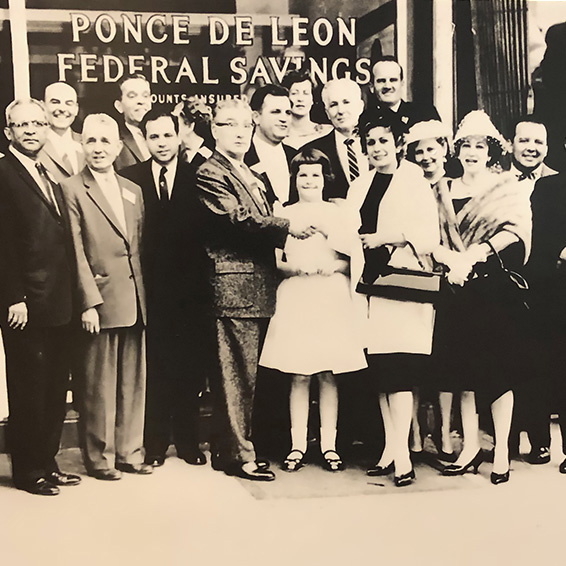
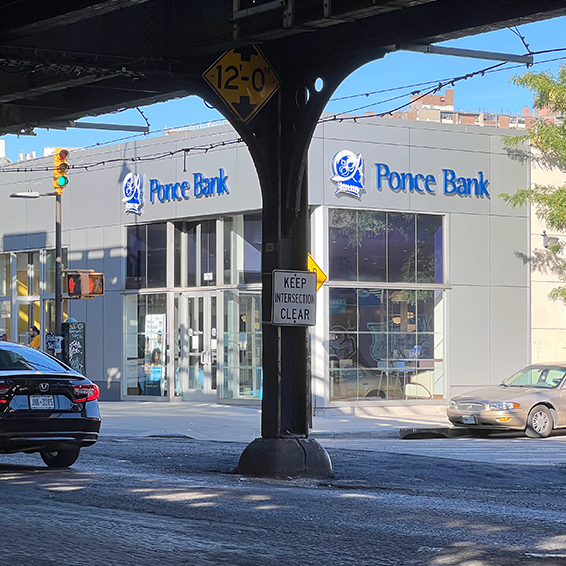

Founded in the Bronx in 1960, Ponce Bank has amassed a portfolio of $690 million in multifamily housing financing that has supported projects like 45 for-sale housing units in Brooklyn's Bed-Stuy neighborhood. Images courtesy of Ponce Bank; Oscar Perry Abello; Gerry Caliendo.
"There's real power and impact when [loan committee members] not only are reading about the borrower or the business on paper, but can also say, 'Oh, yeah, I've met [this person], and we went out there and actually saw [the business],'" says Mary Stoick, senior vice president at Sunrise Banks, a $2.5 billion community bank in Minnesota's Twin Cities.
Construction lending also tends to require deep and extensive local relationships with contractors, architects, engineers, and inspectors. Typically, bank representatives make monthly visits to check in on each active construction project in their portfolio before disbursing a project's next tranche of funding. Banks with $100 billion or less in assets — including both regional and community banks — represent just 30 percent of assets in the banking system, but 74 percent of all construction loans, 78 percent of commercial real estate mortgages, and 58 percent of small business loans among banks.
Bigger banks aren't able to make the judgment calls necessary for these kinds of loans. "Local institutions are more patient," says Caroline Calderon, project manager at Los Angeles-based Little Tokyo Service Center. "I feel they're more willing to find creative solutions to support a project, whether that's extending the maturity date of a loan or offering technical assistance. They're just easier to talk to — the vibe is different."
Institutions matter
Given how important relationships and knowledge of local markets are, each community bank's ownership, staffing, and location influence where they lend. Of those 3,900 community banks, however, only 130 have some kind of minority designation from the FDIC — meaning their ownership or board makeup meets a certain FDIC-designated minority group threshold and the communities the bank serves are primarily of that group.
Overall, as a group, community banks are the least likely to serve majority-minority neighborhoods compared to other lenders, including big banks. Rose Scovel, AICP, an Indianapolis-based planner, says planning school students were taught in the 1990s that redlining happened, "but not how deeply embedded that became in Euclidian zoning or that banks were essentially determining zoning — or creating disinvestment — through lending practices."
But, as a group, minority-designated banks are the most likely to serve majority-minority neighborhoods. There are many reasons why there are so few of them. Pre-existing wealth disparities are a key factor when each community is expected to come up with its own startup capital for a new bank. Black households currently have an average wealth of about $352,000, Hispanic households have $285,000, and white households have $1.5 million.
When it launched in 2023, Columbus-based Adelphi Bank became the first new Black-led bank in 20 years. Its founders broke the mold by reaching out beyond the local Black community to raise $27 million in startup capital from 75 investors, 51 of them local individuals but not all of them Black. Adelphi obtained its Black minority-designation by virtue of most of its board and target communities being African American.
Since its inception, Adelphi has grown to $100 million in assets, including more than $20 million in construction loans and $28 million in commercial real estate mortgages — with an average mortgage size of $593,000, with some mortgages as small as $30,000. Out of the top five ZIP codes that have the most commercial mortgages from Adelphi Bank, three are majority-Black and a fourth is 43 percent Black.
"The hardest part is not so much the underwriting and loans; it's getting those operational deposits," says Jordan Miller, CEO and co-founder of Adelphi Bank. "Once people get comfortable with that kind of stuff, they're more likely to send us deals. That was a big flip we started to see last year."

Little Tokyo Service Center (LTSC), founded in 1979 in Los Angeles, offers a small business program with technical assistance and support for grant applications. Photos courtesy of Little Tokyo Service Center.

The LTSC supports Nellita's Craft in Little Tokyo by facilitating community partnerships and youth engagement programs, such as organizing field trips to her shop for LTSC's Mi CASA after-school program.
Policies matter
Nowadays, even white communities aren't as connected to community banks as they once were. Beginning in the 1980s, legislative and regulatory shifts at the federal and state levels paved the way for the consolidation of the banking sector.
While there are far fewer community banks today than 40 years ago, there are still thousands sifting through potential deals in their inboxes — including deals relying on public subsidies that are often doled out at the discretion of planners or planning commissions. However, planners don't see themselves as part of the business of making things happen, but rather as regulators who say yes or no to developers' proposals, says Breanne Kennedy, AICP, a Twin Cities-based planner.
Development happens differently now. "If we want to foster grassroots community development, from within and for the community, then we have to learn this stuff," Kennedy says. "We can review development applications from big developers all day long. If we want to do things differently, then we have to change our role."
Both Ponce Bank and Sunrise Banks are among the 1,300 federally certified community development financial institutions (CDFIs) across the country. Those institutions include more than 260 community banks, 440 credit unions, 570 revolving loan funds, 12 venture capital funds, and a handful of financial technology-based lenders.
CDFI certification traces back to 1994, when the Community Development Financial Institutions Fund was signed into law. Operating as an arm of the Department of the Treasury, the CDFI Fund came to have two essential functions: certifying CDFIs and administering a range of programs to provide support for certified CDFIs and their activities.
The CDFI Fund's core financial assistance program is unlike almost any other program in the federal government. It functions more like an investment program. Every year, hundreds of CDFIs fill out a complicated application that's part track record of lending and other services, and part business plan for future growth. Chosen applicants receive all their awarded funds in one lump sum, and don't have to submit receipts for specific line items spent based on a pre-determined budget.
Thanks to being structured this way, the CDFI Fund's main financial assistance program can provide "balance sheet capital" that recipients can use to attract deposits or borrow from institutional investors, including larger banks or foundations.
Beneficial State Bank has branched out to other West Coast markets but remains small enough to retain a relationship lending approach. As an example, Beneficial State provided a $770,000 loan in 2015 for the East Portland Community Investment Trust, a first-of-its-kind community-owned real estate trust, to acquire a 29,000-square-foot shopping center on the far east edge of Portland. The shopping center was 33 percent vacant at the time of acquisition but now has a waiting list of local businesses and nonprofits. More than 300 investors have bought into the trust, whose ownership is limited to families living or working in the four working-class, largely immigrant ZIP codes around the shopping center.
CDFIs often work together on deals. At Sunrise Banks, Stoick worked on a deal for a local real estate co-op of more than two dozen local business owners, most of them African immigrants, to acquire the Shingle Creek shopping center in Brooklyn Center, just north of Minneapolis. The co-op members pooled $300,000 of their own savings to invest as equity in the deal, supported by a $1.2 million loan from the Shared Capital Cooperative (a CDFI-certified revolving loan fund also based in the Twin Cities) and a $3.4 million loan from Sunrise Banks.

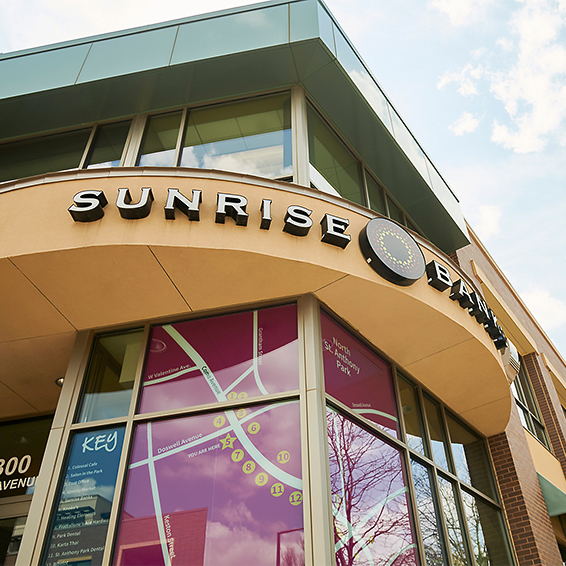
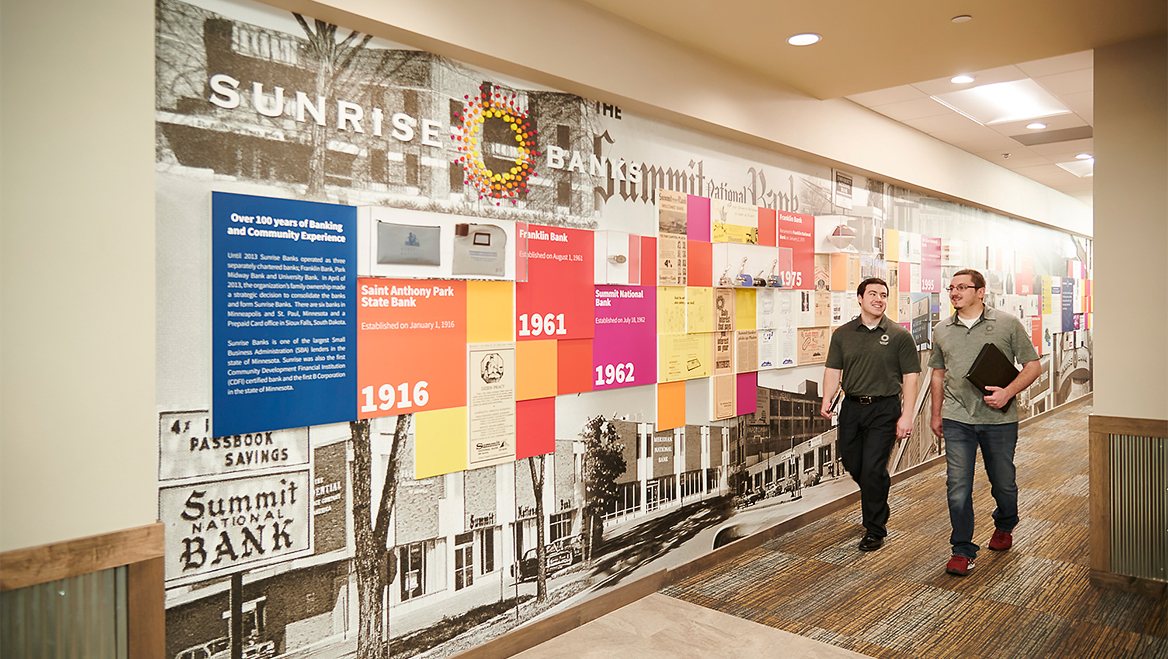
Sunrise Banks, operating since 1916, has allocated NTMC financing for projects along St. Paul's University Avenue corridor, such as a former furniture showroom and warehouse turned mixed-used space, featuring FilmNorth, a community-oriented media arts center. Photo courtesy of D/O Architects; Sunrise Banks.
Tools for intentional dealmaking
The CDFI Fund also administers the New Markets Tax Credit Program, which provides $5 billion in tax credits a year for qualifying investments, largely commercial and mixed-use projects. Investors — mostly large banks — "buy" the tax credits by making seven-year equity investments in projects. After that, the tax credit investors usually transfer their ownership shares to the project sponsor or developer for a nominal cost, typically just $1. The tax credit purchase essentially supplies equity for deals where the underlying borrower or project sponsor doesn't have much cash of their own for equity on a deal.
At the end of the day, there's usually still a loan to make to the underlying project or business to complete the capital stack for a NMTC transaction. That loan often comes from a federally certified CDFI bank, credit union, or loan fund that goes through its own underwriting process.
"We wrote our first [New Markets Tax Credit] application entirely around the theme that one of our busiest corridors in St. Paul was going to be disrupted by the construction of a huge light rail to downtown Minneapolis," says Mary Stoick. "We did that specifically to ensure that the real estate developments and small businesses along that corridor could access low-cost capital to help them stabilize during this incredibly disruptive time."
According to figures provided by the bank, Sunrise Banks has used NMTC to support 18 projects along St. Paul's 965,000-square-foot University Avenue corridor, along with creating or retaining more than 1,950 jobs in low-income census tracts.
Those University Avenue deals include 13 owner-occupied projects for small businesses and nonprofits that contributed as little as 5 percent equity along with the tax credit equity and, if necessary, a commercial mortgage from Sunrise Banks. In some of those cases, Sunrise Banks provided a bridge loan that the project paid off using public subsidies, which typically aren't paid out until construction is finished.
According to the CDFI Fund, CDFIs typically leverage $8 in private capital for every $1 in financial assistance or tax credits it provides. Yet, the role of local banks, credit unions, or community loan funds remains a wide-open secret when it comes to how, where, and why community investment happens — or doesn't.
"The people who are planning the futures of cities should also know how you pay for them, or at least how the money moves through them, because one set of decisions could be really undermining and not in service of the other," says Lourdes Germán, lecturer in urban planning at the Harvard Graduate School of Design. "You don't have to be an expert, but if you're not at least aware, then you've got a real blind spot."
RECOMMENDED ARTICLES