

April 9, 2026
At a time when much of the developed world has reversed the trend of growing roadway fatalities, the U.S. transportation system remains deadlier than ever. When 40,000 people are dying every year on our nation's roadways — around the population of Concord, New Hampshire — with millions more injured, why isn't this treated as an emergency that has to be solved quickly?
All too frequently, decision-makers hesitate to depart from official manuals and guidebooks about how to design and operate roadways. But what if there was a way to designate fatal crashes as emergencies, prompting swift deployment of traffic-calming measures like bollards, speed bumps, and signage?
Imagine if that strategy could empower city officials to act immediately to reduce roadway speeds, one of the main solutions in reducing traffic deaths. And what if it looked remarkably like the methods already used in construction zones?
Emergency Streets might be the answer.
It's all about the physics
More than five decades of planning research in the U.S. has reflected the public expectation that we keep vehicles flowing efficiently on our streets. The idea that the swifter the movement, the more accessible destinations like workplaces, parks, urban centers, and shops appeals to greater numbers of people.
"Rather than removing all traces of a crash and returning roadway operations back to normal, Emergency Streets centers the idea that if 'normal' just killed someone, then all is not well."
"State departments of transportation receive huge infusions of federal funding aimed at building highways," says Barb Chamberlain, director of the Active Transportation Division of the Washington State Department of Transportation (WSDOT). "At WSDOT, we've directly recognized that this leaves out nearly 30 percent of people who don't or can't drive. We built a driving system, and it's time to finish building a transportation system that serves everyone."
The issue comes down to physics. Our transport system routinely allows for kinetic forces that no human body can withstand, inside or outside of a vehicle, when a crash occurs. So, what if — instead of focusing on a driver's inattention, a too-rigid front bumper, or a failure to properly strap in a child — we treat the kinetic energy released in any given collision as the source of injury?
Using that lens, one simple strategy comes into focus: reducing speed. Lower speed, lower kinetic energy, lower harmful impact.
That's why Emergency Streets is such a useful tool. It is a practical, readily available protocol that treats lower vehicle speed as the primary mechanism for reducing the uniquely high toll of traffic violence in the U.S.
After a fatal or serious crash, the Emergency Streets protocol directs city officials to quickly deploy mobile, prominent speed management devices for a full mile around the crash site for a period of two weeks. The protocol slows drivers down in the general vicinity — not just at the crash site, nor when the debris is in the roadway. Rather than removing all traces of a crash and returning roadway operations back to normal, Emergency Streets centers the idea that if "normal" just killed someone, then all is not well.
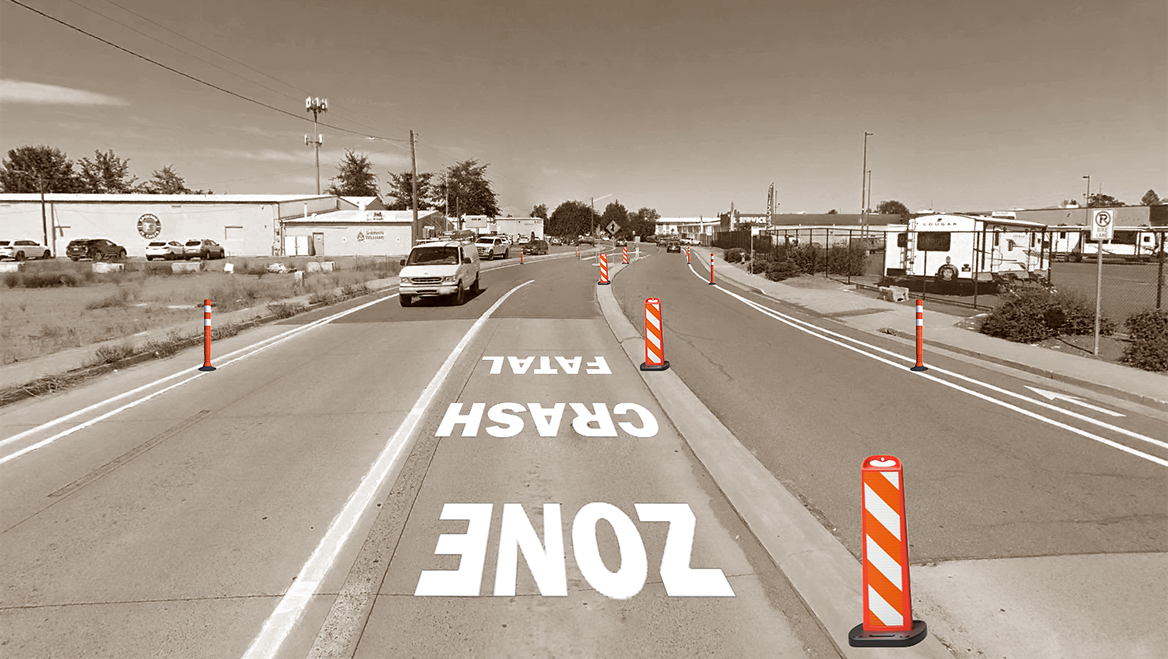
An Emergency Streets kit follows methods already used in construction zones, such as delineators with reflective materials and in-road stencils. Rendering by Cole Percival.
So, what does this look like? The design of Emergency Streets closely resembles standard construction zones that drivers encounter throughout the year, with orange barrels and cones, advance warning signage, and in-road stencils directing drivers to slow down.
A tool for 'creating a culture of safety'
We've traveled the U.S. and internationally to test the waters for this idea, asking first responders, city managers, and transportation professionals, among many others, for their reactions. Initial responses to this proposal reveal deeply ingrained discomfort with making drivers slow down by design. We've heard concerns about driver frustration, confusion, and perceptions of worse road safety in Emergency Streets communities.
However, continuing to operate by the same standards lends no solace to the families of the thousands of people injured and killed on U.S. roads every year. Having hundreds of thousands of people be directly affected by traffic violence annually tell us that the status quo is unacceptable and unsustainable. A systemic change is necessary, but the tapestry of our transportation network seems impossible to reweave.
In March of this year, the Washington Traffic Safety Commission and the National Highway Traffic Safety Administration awarded $136,000 to Spokane, Washington, to support the city's ongoing work in developing and implementing Emergency Streets for its road programs. This includes pilot testing traffic-calming measures at sites where fatal crashes have occurred.
"We have to fight this idea that traffic fatalities are acceptable collateral damage in our transportation system," says Jon Snyder, director of transportation and sustainability for Spokane. "A highly visible indication that someone has died will be a strong tool for creating a culture of safety, which we desperately need."
Maybe by pulling on the common thread of speed mitigation, Emergency Streets can refocus planners, engineers, and transport professionals into a new alignment to tackle an unacceptably persistent problem.
RECOMMENDED ARTICLES