



Feb. 26, 2026
In 2023, Montana pulled off an amazing feat — a sweeping set of legislation aimed at mitigating the housing shortage crisis that has left Montanans with soaring rents. Dubbed the "Montana Miracle" by national media, this package of laws overrode local restrictions that favored single-family housing and became a national example of what bipartisanship can do.
Emily Hamilton, a senior research fellow and director of the Urbanity Project at the Mercatus Center at George Mason University, says that similar laws about accessory dwelling units and multi-use development have been passed in other states, but what was especially impressive about Montana was the "widespread agreement on the seriousness of the problem" and "the speed [at in which] Montana went from not having these YIMBY (Yes In My Back Yard)-era laws to having a lot of them at once."
These wins, however, have hit roadblocks along the way, including a lawsuit challenging the constitutionality of the core tenets of the laws. But two years and some judicial intervention later, the impact of the Miracle can be seen in various ways.
Bridging the political divide
Montana has always prided itself on its natural landscapes and its smaller, close-knit communities. But a study from the Pew Charitable Trusts found that Montana's population increased 10 percent between 2010 and 2020, while housing units only increased by 7 percent. According to Zillow, the average housing price in Montana rose 36 percent between January 2020 and January 2023.
When Alison Mouch, AICP, a managing partner at Orion Planning + Design in Missoula, moved to the state in 2008, she says it was expensive, but manageable. After the effects of the Great Recession and an influx of new-to-the-state homebuyers during the pandemic a decade later, though, the issues of supply and affordability were exacerbated. "A lot of those people still retained their homes from wherever they moved from," she says, "so, there was a lot of second and third homeownership, a significant amount of accessory dwelling unit construction, and then [an impact] on the [rental] markets."
Increased demand led to a shortage of housing and an increase in housing costs. "I blame Kevin Costner for that," jokes State Sen. Forrest J. Mandeville, AICP, referencing Yellowstone, the popular television drama.
The issues were not helped by stagnant wages and a downward trend in construction since 2008. For example, in Bozeman, the state's fourth-largest city, vacancy rates were approaching zero, says Chris Saunders, AICP, the city's community development manager.

Increased demand for housing in Montana led to a shortage in Missoula (above), as well as in Bozeman and Whitefish. Photo by Jon Bilous/iStock/Getty Images Plus.
However, the issue isn't all that new — housing in Montana has long been a challenge, with many areas having outdated or nearly century-old rules, mainly for subdivisions. "Even before the housing affordability issue, we kept seeing legislators try to come in and do minor fixes to either the subdivision statutes or the zoning statutes to deal with a particular issue that had come up for a particular developer, and so they were just getting worse," says Kelly Lynch, AICP, executive director of the Montana League of Cities and Towns.
There's also resistance to multifamily development, with communities fearing that large apartment buildings will change their way of life. "The general vibe around growth is one of skepticism," says Nathan Dugan, founder of Shelter WF, a housing affordability advocacy group in Whitefish. "People activate and go to meetings and make their councils vote these things down pretty easily."
It was under these conditions in July 2022 that Montana Gov. Greg Gianforte convened a 26-member housing taskforce — comprised of Republican and Democratic state lawmakers, officials, developers, realtors, researchers, bankers, planners, and activists — to come up with recommendations to tackle affordability, zoning reform, supply-side incentives, and workforce development. "We really homed in on regulations and how restricting density in the cities forces development to sprawl outwards, and that takes over a lot of the surrounding rural areas," says Kendall Cotton, a taskforce member and president and CEO of the Frontier Institute.
The Montana Miracle comprises four laws, which — among other things — allows duplexes in areas zoned single-family-only in places with a population of more than 5,000, requires at least one accessory dwelling unit (ADUs) in single-family areas as a by-right use, and legalizes multifamily and mixed-use buildings in commercial zones. To Cotton, this was a message that resonated across political divides. The left, for example, was motivated by environmental protection; free-market proponents by property rights; and conservatives by the preservation of agricultural communities.
Housing efforts face legal challenges
While the Miracle legislation passed nearly unanimously in the majority-GOP legislature, not all were pleased.
In December 2023, a group of about a dozen homeowners, calling themselves Montanans Against Irresponsible Densification (MAID), filed a lawsuit against the state. They allege that the laws undermine the state constitution's right to public participation and that some cities and counties were being treated unfairly. "I dread the possibility of waking up one morning and finding that one of my neighbors has sold her property to a developer who is then erecting a multi-unit building or a duplex, or an accessory dwelling unit right next to our nice and carefully maintained single-family dwelling," one of the plaintiffs wrote in an affidavit supporting the lawsuit.
A judge then issued a preliminary injunction against the ADU and duplex laws. The Montana Supreme Court overturned the district court ruling eight months later, allowing the two laws to go into effect. Then, in March 2025, a Gallatin District Court judge rejected some of the plaintiffs' arguments while deeming aspects of the public participation provisions in the Montana Land Use Planning Act (MLUPA) — which was developed and passed concurrently with the Miracle legislation — as unconstitutional.
"What we see a lot of times is a fear of the unknown, but once something is actually built, or being built, people realize it's not that big of a deal."— Nathan Dugan, founder of Shelter WF and executive director of Livable Flathead
While the case is still waiting for appeal to the state supreme court, the American Planning Association (APA) issued an amicus brief in support of the legislation. "MLUPA ensures robust, continuous public participation where it is most effective: where community members' knowledge of their neighborhoods and goals and visions for their respective futures can inform planning and policymaking," reads the amicus brief. "It also ensures an appropriate place for technical planning expertise during the implementation of plans and policies, that is, during site-specific application review."
The lawsuit hasn't stopped housing advocates. In spring 2025, the Montana state legislature, which meets biennially, came back and passed a "Montana Miracle 2.0," as Cotton calls it.
These new laws legalized ADUs in the rest of the state, re-legalized single-stair residential buildings, transferred the authority for historical preservation permits to city staff over volunteer-run boards, overrode local height restrictions to allow buildings of up to six stories, and cut parking mandates for most multifamily buildings.
Is it working?
Most people Planning spoke with say it's too early to see a major impact on housing construction and affordability. The Montana Budget and Policy Center estimates a deficit of around 15,000 rental units for low-income households. Cities are not required to follow MLUPA until May 2026.
Some communities might not see a huge change at all. Saunders says Bozeman hasn't been affected as much by the Miracle since the city has long practiced many of its tenets, such as allowing ADUs, duplexes, and apartment complexes.
Mouch, the Missoula planner who also serves as an APA board member, says a lot of places in the state had already started zoning reforms before passage of the Montana Miracle and should be commended for having that foresight.
An early success is Whitefish, near Glacier National Park and one of the fastest-growing communities in the state, where new housing projects are cropping up. That's a good thing since, between 2020 and 2023, the population of Flathead County — where the city is located — jumped 8.3 percent, and the average home sale price rose 71 percent from 2019 to 2021.
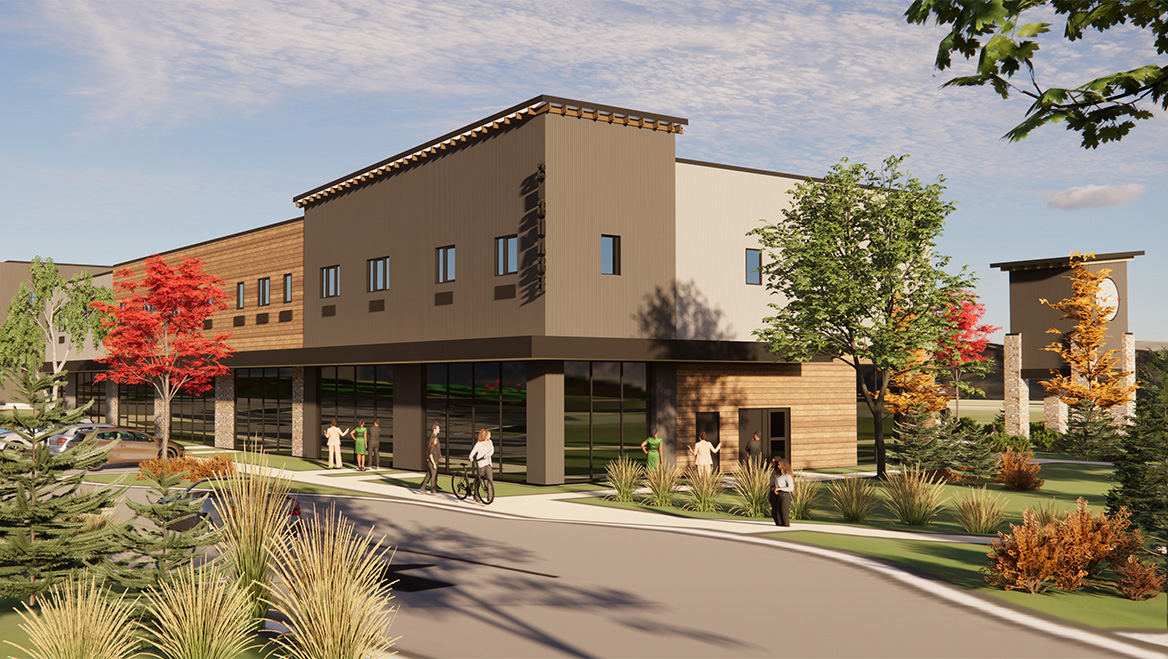
Alpine 93/40, a mixed-use development in Whitefish, Montana, will provide affordable, below-market-rate units and market-rate units considered attainable for tenants. Image courtesy of Alpine 93/40/Cushing Terrell.
Dugan, of Shelter WF, attributes the construction of two developments to the Miracle. Peregrine Subdivision is a 40-unit apartment complex that includes eight deed-restricted affordable units and a gym. Construction began at the beginning of 2025. Also under construction is Alpine 93/40, a mixed-use development just south of Whitefish that is expected to have 210 rental units (10 percent of which are deed-restricted affordable housing) and 15,000 square feet of retail space, in addition to a gym, playground, and dog park. When the first units open in summer 2026, the project will be on its way to help Whitefish reach the 930 units it would like to build by 2035.
"What we see a lot of times is a fear of the unknown, but once something is actually built, or being built, people realize it's not that big of a deal," says Dugan.
Whitefish also is currently developing a new growth policy, but Dugan, who is executive director of Livable Flathead, feels that the city's planning commission has had too much influence by trying to remove references to mixed-use development and limit where housing can be built. "For me, more economic development and diversifying our economy with better-paying jobs would ultimately mean that more homes need to be built in Whitefish," he says.
Lessons from the Montana Miracle
While Montana waits for the decision by the state supreme court, the people on the ground there have ideas about ways other places can replicate the Miracle's successes.
Saunders, of Bozeman, advises planners to write their zoning codes knowing they will have to be changed eventually. "Code cannot be static," he says. He advises planners to think about "what programmatic portions you have in place to ensure that you're evaluating the effectiveness of your regulations, making adjustments as needed to keep them tuned to the needs that are there."
Kiah Hochstetler, a partner at Goodworks Ventures, an impact fund investing company in Missoula, adds that creative solutions, such as public-private partnerships and tax increment financing, are crucial to supply-side success. "We need to find consistent tools we can utilize and find quality local developers to create housing supply. Otherwise, our communities can't grow, the people who want to live here can't afford to and they choose to move out, and it creates stagnation," he says.
For Mandeville, the state senator and planner from Columbus, building a broad coalition is key. "In the Montana Miracle, we had Realtors™ on the same side as the environmental groups [and] the local government groups," he says. "There's going to be some disagreement, so don't be afraid of [that]."
He also has advice for fellow planners. "I don't think planners should be afraid to get involved in political processes and tell elected officials what issues we're seeing, or what the incoming development pressure is looking like," Mandeville says. "[We can help] those decision-makers make better decisions.
"We shouldn't be abdicating our responsibility."
RECOMMENDED ARTICLES