

Jan. 8, 2026
In the 1970s, architect and urban designer Christopher Alexander embarked on a project to find a new way of understanding the work of planners and designers. In his book, The Timeless Way of Building, Alexander envisioned "a process which brings order out of nothing but ourselves; it cannot be attained, but it will happen of its own accord, if we will only let it."
Alexander's writings are evocative, insightful, and often poetic. The final volume reads more like the I Ching than a work of architectural theory. But because of the technology of the time and the economics of publishing, the books relied primarily on grainy black-and-white photos and line drawings, so they never fully succeeded in capturing the qualities they described so passionately.
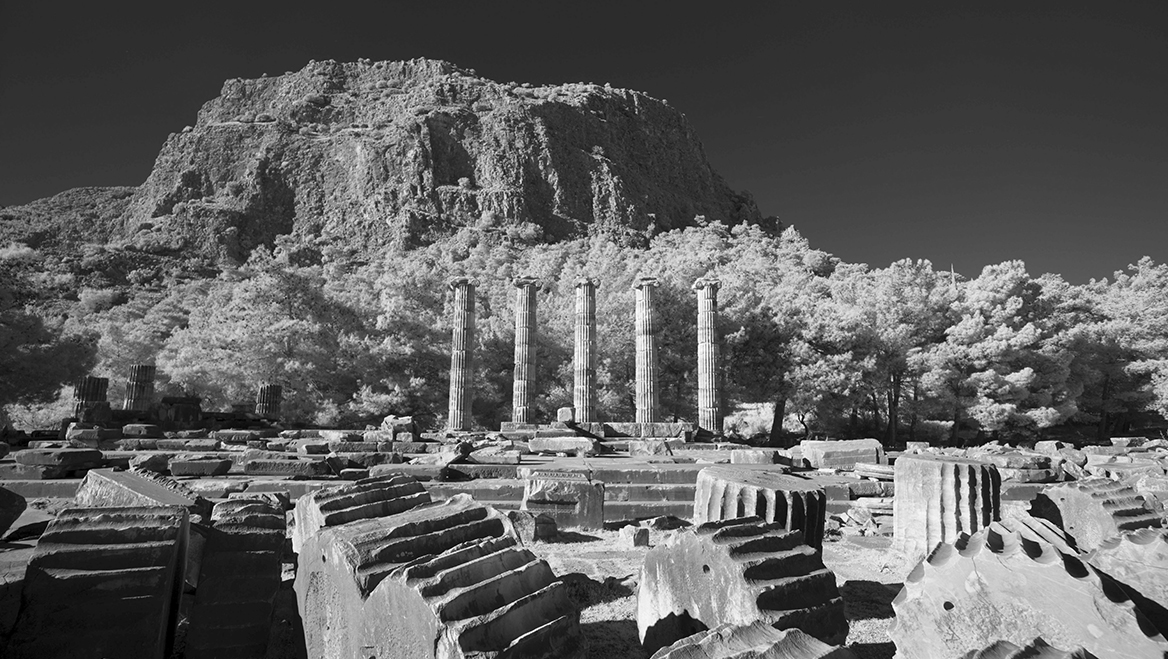
Nearly 50 years later, Architecton, directed by Victor Kossakovsky, beautifully fills this gap, providing a wise and artistic meditation on exactly how the act of building can be "timeless." Although the experimental film never directly references Alexander's books — or much else, as it's essentially a wordless visual essay on film — it touches on the same themes that defined his work, like nature, permanence, balance, order, pattern, texture, and adaptive design.
Through a non-linear narrative with long tracking shots and patient camera work, Architecton explores ancient quarries and contemporary strip mines, stone walls and earthworks, classical ruins and modern architecture, intricately balanced sculptures, and aerial drone imagery from war-ravaged cityscapes. Kossakovsky and cinematographer Ben Bernhard work as master builders, as they slowly layer themes of order and stability — as well as erosion, chaos, and sudden cataclysmic change — into a balanced, beautiful structure.
The film's most memorable scene captures a seemingly endless rockslide in slow motion and in booming surround sound, conveying the awesome power of nature in transition. Architecton is worth seeing in a theater for this scene alone.
Ultimately, the film allows us to simply watch and wonder about what is fleeting and what is timeless — and what is our relationship to the earth and the things we build. As philosopher Ludwig Wittgenstein said, "Whereof one cannot speak, thereof one must be silent."
Architecton is screening around the county at various art houses and independent cinemas and festivals. It's also available for home-viewing through AppleTV, HBO Max, Amazon, and other major streaming platforms.
If you liked Architecton, you may also enjoy ...
KOYAANISQATSI (1982)
The original experimental film essay on nature, technology, cities, and our increasingly hectic world broke into the art-house scene in the early 1980s. Directed by Godfrey Reggio with a minimalist-classical score composed by Philip Glass, the film presents stunning footage of a world of growth, speed, change, decay, violence, urbanization, and destruction.
Koyaanisqatsi is available to stream on Prime or Tubi.
MANUFACTURED LANDSCAPES (2006)
The first in a trilogy of movies, this collaboration between director Jennifer Baichwal and photographer Edward Burtynsky finds beauty in devastation and industrialization, without ignoring the human and environmental costs. From sprawling factory assembly lines and toxic "shipbreaking" operations in Bangladesh to the construction of the massive Three Gorges Dam in China, the film allows us to reflect on the ever-increasing ways we are changing our world.
Manufactured Landscapes is available to stream on Prime and Tubi.
AQUARELA (2018)
Trading stone and concrete for water and ice, Kossakovsky's previous film provides an equally wordless visual examination of the materials of nature and the ways humans interact with them.
Aquarela is available to rent or purchase on Prime.
RECOMMENDED ARTICLES