
June 18, 2026
On October 30, 1975, the New York Daily News made history with a shockingly blunt headline: "FORD TO CITY: DROP DEAD."
For the better part of that year, New York City was teetering on the brink of financial disaster, and without a federal bailout, most experts feared bankruptcy was days away. And while the curt headline misquoted President Ford's actual words, the statement succinctly captured the administration's position on the use of federal funds to rescue the city.
How the Empire City arrived at this breaking point — and how city and state officials charted a difficult course back to fiscal stability — is the subject of Drop Dead City, a thoughtful and entertaining new documentary by directors Michael Rohatyn and Peter Yost. Using a combination of archival footage and current interviews, the film immerses viewers in New York City in 1975 as the city struggled to meet its financial obligations.
The financial structures that support our central cities and their essential public services are extremely complex, politically sensitive, and often impenetrably confusing, enshrouded in Byzantine fiscal instruments, obscure terms, acronyms, and — gasp! — actual math. All too often, the important details of vital funding mechanisms and tax policies are ignored by the public — and for good reasons: they just seem so darn boring. I could probably convince most readers to skip to the next article by just mentioning things like budget reconciliation, special assessments, revenue bonds, ad valorem taxes, appropriations, debt restructuring, deficit spending, and entitlement formulas — are you still with me?
Boring or not, these fiscal details are also extremely important to the steady functioning of our cities and the work we do as planners. Even small changes in tax policies or bond rates can mean the difference between a healthy and prosperous city and one on the verge of collapse.
As the film explores, there is a basic formula required for good financial health: revenues need to cover expenses. Revenue can come in many shapes and colors, from local taxes and special assessments to state and federal transfer payments, user fees, or property sales. Expenses, though, can be hard to predict or control and are often connected to other fluid dynamics. Compounding all of this, bankers, auditors, and comptrollers have developed 1,001 tricks to restructure debts and juggle expenses to allow governments to meet current obligations and close budget gaps without addressing the underlying structural issues — all of which can seem like clever management, until the bottom falls out and it looks, in retrospect, very much like a giant public-finance Ponzi scheme.
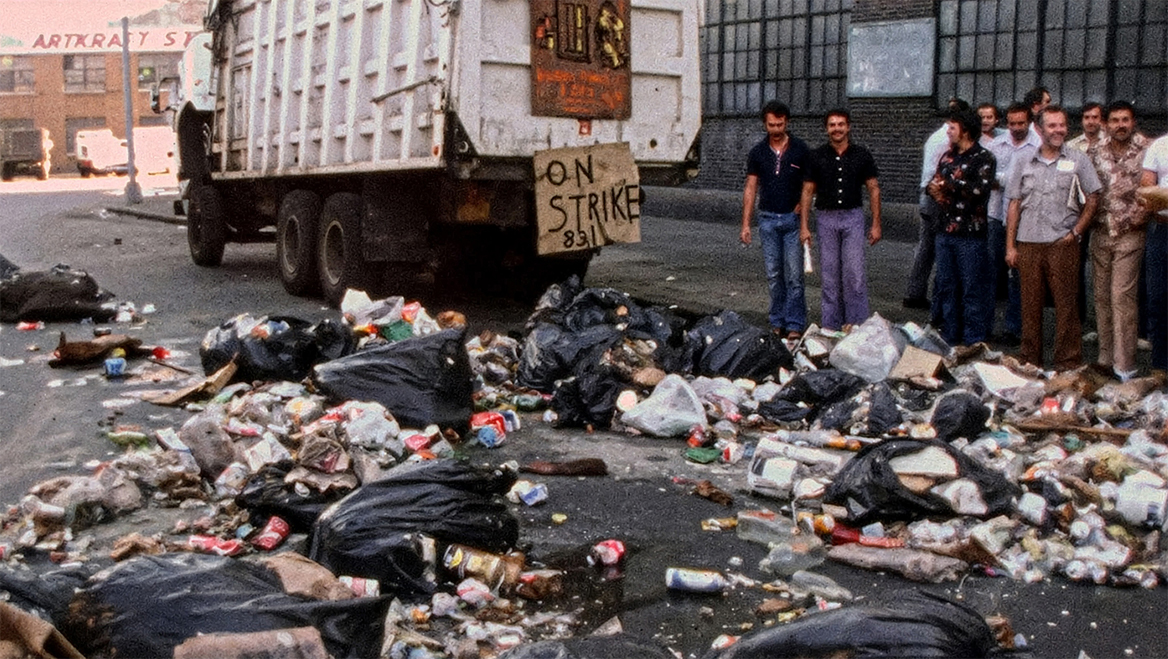
After the realization that future revenues would not meet current debt obligations, auditors uncovered a $6 billion hole in New York City's budget. A failed bond issue with no takers made it clear that the city could no longer borrow its way out of the problem. Soon, bills were due without funds to cover them, leading to cycles of cuts, layoffs, tuition increases, hospital closings, public protests, and other dramas, which played out in the streets and in the news.
Given the complexity of the crisis, it would be difficult for any 90-minute documentary to fully explore every aspect of its history, but Rohatyn and Yost do an admirable job laying out the debate in an engaging way. While fiscal budget hawks claim that decades of policies funding public services and union contracts led to deficit spending and an unsustainable future, fans of these social programs point out they expanded the middle class for millions of New Yorkers.
Others will find truth in between, noting unanticipated structural changes in the global economy, including inflation and rising labor costs, the flight of capital, aging infrastructure, shifts in the manufacturing base, and the 1973 Organization of the Petroleum Exporting Countries (OPEC) oil crisis.
There was more than enough blame to go around, and the film allows us to decide how much to assign and to whom. Beyond these arguments, the film really hits its stride when it centers the work of the Municipal Assistance Corporation, a stage agency chartered in 1975, known affectionately as "BIG MAC."
It's refreshing to see a movie where the heroes are the people wearing white shirts, pocket protectors, and green visors — in short, the planners — who came together to analyze the data, negotiate with stakeholders, build trust, and think creatively. (Full disclosure: a key "hero" in this work was Felix Rohatyn, chairman of BIG MAC, the father of one of the film's codirectors.)
It's probably no spoiler to share that the crisis was, in fact, solved. Despite the president's harsh words, New York lived to see another day. The city's salvation did not come easily or cheaply, and there were difficult compromises all around. As current debates roil over affordability, gentrification, development displacement, and "fair share" taxes, we would be wise to revisit this past and learn what we can from it.
Drop Dead City is available to purchase on Fandango at Home, Apple TV, and Amazon Prime Video.
If you liked Drop Dead City, you may also enjoy ...
Decade of Fire (2019)
In the 1970s, the fundamental breakdown of New York City was most graphically seen in the arson crisis that swept through the South Bronx. Originally glossed as a problem of rogue arsonists, underfunded fire departments, aging infrastructure, or isolated insurance scammers, the full story is explored in this personal and painful documentary directed by Vivian Vázquez Irizarry and Gretchen Hildebran.
Decade of Fire is available on most major streaming services.
NY77: Coolest Year in Hell (2007)
First aired on the now-defunct VH1, this documentary, directed by Henry Corra, looks back on 1977 to celebrate the birth of hip hop and the emergence of an entirely new urban style that gestated in the ashes of economic decline and civic decay.
NY77: Coolest Year in Hell is available to watch on YouTube.
RECOMMENDED ARTICLES