

March 5, 2026
Greg Huss, AICP, always wanted to be a planner. He just didn't know what it was called.
"When I was a kid, my dad worked at the local newspaper," says Huss, a planner with the Farnsworth Group in Normal, Illinois. "He would bring home these big rolls of paper, and I'd spread them across the entire basement floor and draw cities for little Hot Wheels cars. I didn't know that was me wanting to be an urban planner."
It wasn't until Huss got to Ball State University that he learned about the profession. Now, he is helping build the pipeline of future planners by combining it with his other lifelong passion: baseball.
Huss recently spoke to seventh-graders in Kirkland, Illinois, about issues including economic development, housing, infrastructure, equity, and affordability — all through the lens of finding a home for a Major League Baseball (MLB) expansion team.
"It gave the students ideas for the infrastructure needed and how things in a neighborhood work in concert with one another," says Todd Johnson, Ed.D, the teacher who tapped into Huss's expertise for the class project. "A stadium by itself does nothing if it has no other support."
But how did Huss wind up talking to a group of students more than 120 miles away about urban planning? Well, that story begins in the minor leagues.
Patterns, pipelines, and player development
If not for planning, one might think Huss's true love was the Chicago Cubs. Even though he scoured the internet for information about the team's young stars and prospects, he grew tired of seeing new players on the TV screen without knowing who they were.
So, he began digging into old box scores and watching broadcasts of the Cubs' minor league affiliates. Eventually, that newfound interest developed into a podcast — Growing Cubs, for Cubs Insider in 2019, and then Cubs on Deck, which launched in 2023.
Huss sees connections between his podcasting and planning work, such as grant writing proposals. "If you can tell a story and pay attention to the ins and outs of the notice of funding opportunity, you're looking pretty good," he says.
He met Johnson, a teacher at Hiawatha Jr. High School, through his podcast work. They bonded over their shared interest in Cubs' prospects, even partnering on a website covering the team. In 2024, though, Johnson wanted to drill into a different part of Huss's brain.
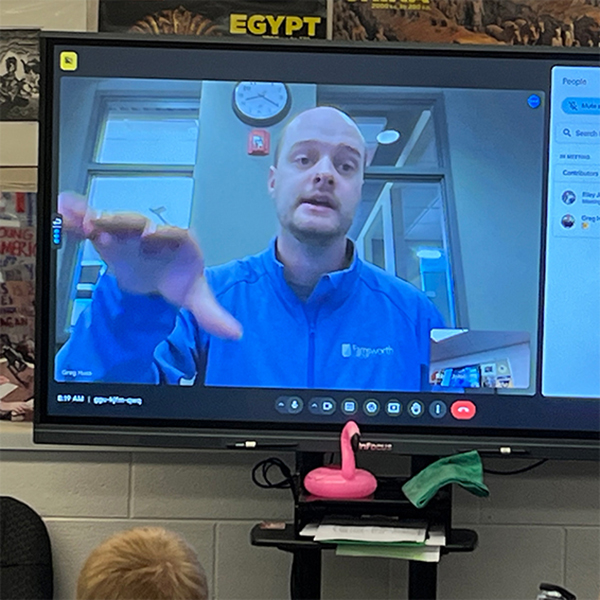
Greg Huss, a planner in Normal, Illinois, spoke on a video call to Todd Johnson's seventh-grade geography class for a project. Photos courtesy of Todd Johnson.
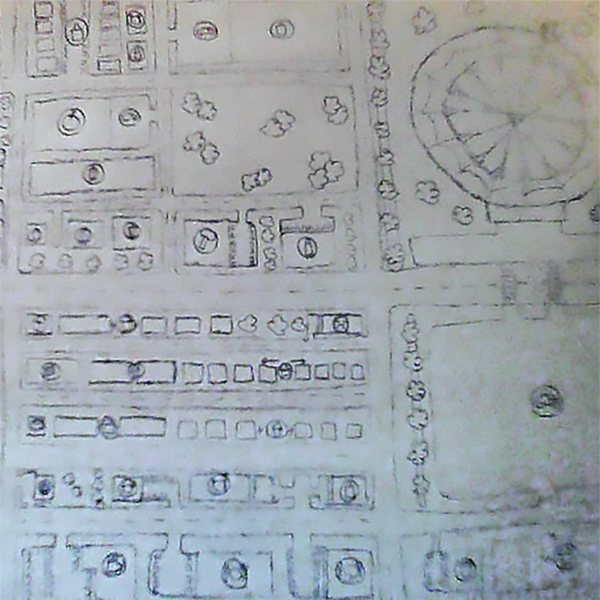
A student's project shows the livability and financial impacts of a new ballpark in a neighborhood and how the seventh-grader tried to make theirs a year-round place to visit.
While working on a geography class project about cities of the future, Johnson asked Huss to meet with the students and share how urban planning shapes places. The catch? The project would focus on baseball. Each student selected a city from a list of possible MLB expansion sites — such as Montreal, Nashville, and San Antonio — to create a ballpark neighborhood with amenities, Johnson says.
In a video conference call, Huss taught the students about scale and other planning considerations, including looking at metropolitan areas rather than city populations; trends in how and where ballparks are built; the livability and financial impacts on surrounding neighborhoods; and the potential economic development and revenue that might be created.
"I was trying not to get too into the weeds," Huss says. "A main point of the conversation was on if it was better to have some shopping districts, bars, and restaurants around the park or if it was important to have apartments, because you want people there more than just from 7 or 8 p.m. to 10:30 p.m. on a Tuesday."
Huss says the questions students asked — both that first time and then again when he helped a new class in October 2025 — leaned more aspirational than practical. "To me, that's the coolest thing," he says. "That's where you really start as a planner: the pie-in-the-sky items."
Johnson says students learned the different ways that something new — like a ballpark — can influence other parts of a neighborhood. "They realized they could not just have a row of restaurants," he says. "They tried to make their neighborhood a year-round place to visit."
That approach to engaging with students — distilling down convoluted planning concepts into simple aspects of everyday life — is a strategy that other planners are using, including the Washington Chapter of the American Planning Association (APA). "A lot of times, we as adults underestimate what students are able to grasp," says Stephanie Velasco, AICP Candidate, and co-chair of APA Washington's Youth in Planning Task Force.
A goal of the task force was, in part, to build up the next pipeline of planners while finding ways to teach foundational planning concepts to young people, like helping to create and pilot test a curriculum for fourth-graders in Bellevue, Washington. It also led to the creation of Washington, By and By — a 48-page graphic novel following four teenagers as they face issues pertaining to development, equity, displacement, and preservation. The story is free to download on the APA Washington website.
Planning can be 'cool'
When it comes to building the pipeline of future planners, Huss thinks people focus too much on defining the field. "Instead, we should say that we do cool things and explain those cool things," he says.
Ideally, that memory can later encourage young people to study urban planning in college. "We want to continue to build this profession and make sure students better understand what they can do with planning," Huss says. "There's so many different areas you can go into."
Velasco feels there is a social call to action, too. "I think a lot of young people today feel like they want to make some kind of change in their community or the world," she says. "Planners plan and build our cities, and shape how we live and how we live together. So, if you want to make a positive change in your community that can potentially impact people for generations, planning is one way to do that."
For Huss, he's taking it one pitch, one swing, and one at-bat at a time, starting with those seventh-graders at Hiawatha Jr. High. "Hopefully one is more intrigued by urban planning than they were a week ago," he says.
RECOMMENDED ARTICLES