

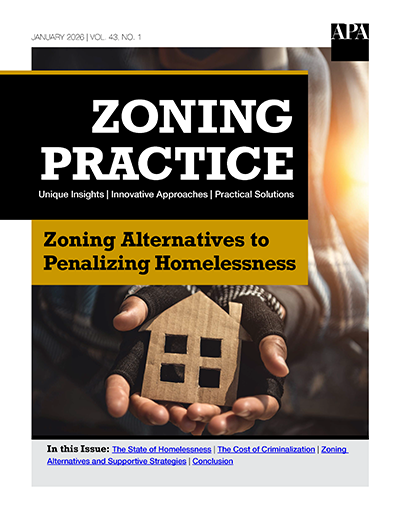
Zoning Alternatives to Penalizing Homelessness
Zoning Practice — January 2026
By Chasidy Miles, Lauren Week
Not a member but want to buy a copy? You'll need to create a free My APA account to purchase.
Create account
In June 2024, the U.S. Supreme Court issued its decision in Grants Pass v. Johnson, 603 U.S. 520, which sanctioned the use of local camping prohibitions, even if the “campers” in question have nowhere else to go. Later that year, the U.S. Department of Housing and Urban Development (HUD) released its Annual Homelessness Assessment Report, revealing that 771,480 people experienced homelessness—an all-time high (albeit likely still an undercount). More than a third of these individuals slept in places not meant for habitation.
In response to the ruling, local and state governments across the country are adopting new ordinances or fortifying existing laws that target the unhoused by prohibiting sleeping or lingering on public property. Failure to comply can result in fines, imprisonment, or forced relocation. Despite the risk of increasingly severe punishment, homeless populations often return to the spaces that officers or government staff previously removed them from. This “whack-a-mole” tactic repeatedly fails to deliver positive outcomes.
This issue of Zoning Practice explores regulatory alternatives to criminalizing homelessness. Following a discussion of the state of homelessness and the costs of criminalization, it outlines zoning and land-use-based solutions that balance the rights of the unhoused with a jurisdiction’s duty to promote public health, safety, and welfare.
Details
About the Authors
Chasidy Miles
Chasidy is an affordable housing professional with over seven years of experience in policy analysis, stakeholder engagement, program management, and LIHTC finance. She holds a B.A. in Social Welfare from UC Berkeley and Master’s degrees in Real Estate and Urban Planning from Cornell University.
Her work has spanned finance, housing policy, and program development, with a focus on preventing displacement, improving habitability standards, and advancing equitable housing policies. As a Partnership for the Bay’s Future Fellow, she works with RAMP, La Clinica de la Raza, Black Cultural Zone, EBALDC, and the City of Oakland to develop Oakland’s Equitable Lead Hazard Abatement Program (ELHAP) and Proactive Rental Inspection Program (PRIP), both of which aim to address longstanding health and safety concerns in rental housing.
Prior to the Fellowship, she financed affordable and workforce housing at JPMorgan Chase, led anti-displacement efforts in San Mateo County, and researched artist live-work housing in memory of a close friend who was a victim of the Ghost Ship fire.
Lauren Week
Lauren currently works as an environmental lawyer in the public sector focused on enforcement and defense of natural resources law. She previously clerked in Hawai‘i in the state’s specialized environmental and land use court. Lauren has had the opportunity to research zoning policy and reform, affordable housing, economic development, and environmental and spatial justice with the support of the Fiske Fellowship, Wyss Conservation Fellowship, Fulbright-Nehru Research Fellowship, and as the former APA Planning and Law Division Curtin Fellow and Research Assistant. She received a Juris Doctor and Master of Urban and Regional Planning from the University of Michigan and a Bachelor of Arts in Legal Studies and Political Economy from the University of California, Berkeley.