
2026 Trend Report for Planners - Screen Reader Version
By Petra Hurtado, PhD, Ievgeniia Dulko, Senna Catenacci, Joseph DeAngelis, AICP
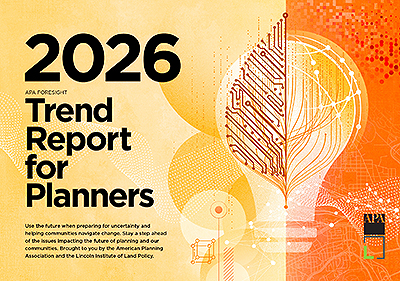
APA Foresight helps planners navigate change and prepare for an uncertain future. With foresight, planners can guide change, create more sustainable and equitable outcomes, and establish themselves as critical to thriving communities. Foresight is not about predicting the future — it is about understanding drivers of change that are outside our control, how we can prepare for them, and when it is time to act. APA Foresight identifies emerging trends and how scenarios stemming from each may impact the world, our communities, and the planning profession in the years to come.
This is the fifth Trend Report for Planners developed by the American Planning Association (APA) in partnership with the Lincoln Institute of Land Policy. As in previous years, the 2026 Trend Report features a list of over 100 existing, emerging, and potential future trends that the APA Foresight team and our Trend Scouting Foresight Community identified as relevant to planning. The trends are structured within three timeframes (Act Now, Prepare, Learn, and Watch), which indicate the urgency of planners' actions. Within each timeframe, trends are grouped into themed clusters. For each trend, the report gives insights and explains why it is important for planners to know about and consider the trend in their work. All trends and signals are based on facts and are neutrally described without judgement.
This report was developed in partnership with the Lincoln Institute of Land Policy.
Details
About the Authors
Petra Hurtado, PhD
Petra (Stieninger) Hurtado, Ph.D. is the Chief Foresight and Knowledge Officer at the American Planning Association, leading APA's foresight program and knowledge portfolio, including research, publications, educational content, and career services. She has a Ph.D. in urban planning from the Vienna University of Technology. Her areas of expertise and research include strategic foresight, futures literacy, urban futures and emerging technologies, urban sustainability, and environmental psychology. Before joining APA, Petra worked as an advisor, planner, and educator in the global sustainability arena. As an adjunct professor, Petra has taught courses on planning with foresight at the University of Maryland and on urban sustainability and environmental psychology at the Vienna University of Technology. She has presented as a keynote speaker at numerous conferences across the globe and guest lectured at Harvard GSD, Virginia Tech, among other universities.
Ievgeniia Dulko
Zhenia Dulko is currently a foresight manager at the American Planning Association, where she focuses on developing the annual Trend Report for Planners and on applying strategic foresight in the planning profession. Zhenia holds a master’s degree in city/urban community and regional planning from the University of Illinois Chicago and a BA and MA in political science from Petro Mohyla Black Sea State University.
Senna Catenacci
Senna is a graduate of the University of Michigan with degrees in Environment and Political Science, and currently works at the American Planning Association. She conducts research for APA's grant-funded projects and Foresight initiative, primarily in helping with the development of the annual Trend Report.
Joseph DeAngelis, AICP
Joe DeAngelis, AICP, is a planner and research manager at the American Planning Association, where he manages projects on climate adaptation, natural hazard risk, and community resilience. Joe has co-authored a variety of publications while at APA, including the 2020 Planning Advisory Service Report “Planning for Infrastructure Resilience” and since 2021, APA’s annual Trend Report. Joe is also the co-author of the upcoming report “Exploratory Scenario Planning for Hazard Mitigation and Climate Adaptation.” Before coming to APA in 2016, Joe worked as a Resilience Planner for the New York City Department of City Planning, where he focused on post-Hurricane Sandy recovery and long-term redevelopment. He holds a Master of Urban Planning degree from CUNY-Hunter College.
Table of Contents
The Framework
About This Report
How to Use This Report
An Inclusive Approach to Futures
About the American Planning Association and the Lincoln Institute of Land Policy
The APA Team Behind the Trend Report
APA's Trend Scouting Foresight Community
APA's Trend Universe
The Trends We Need to Act on Now
Intensifying Bonds Between Humans and Chatbots
Community Rights, Culture, and Safety at Risk
Institutionalizing and Weaponizing Disinformation
Political Violence in the 21st Century
Public Schools Under Pressure
Regulatory Rollbacks Pose Environmental Risks
Disrupted Paths, Shifting Nation
The Trends We Need to Prepare For
Changing Climate Approaches in the Private Sector
Funding Cuts Fuel Uncertainty in the U.S.
New Lows for Higher Education
Policy Shifts Not Working for Labor Markets
Public Transit Faces Growing Uncertainties
Tariff Costs Take Hold for Businesses and Households
Tectonic Shifts in U.S. Foreign Policy
The Trends We Need to Learn and Watch
Global Issues, Local Impacts
A Constellation of Developments in Outer Space
Privacy Will Never Be the Same
Mixed Prognosis for Worldwide Public Health\
Emerging Sustainability Solutions
Our Tech-Shaped Future
The Future of Planning
Embracing Uncertainty
PlanTech: Upgrading the Planner's Toolkit
Conclusion