

The State of the 'States': Housing Top of Mind
Governors Prioritize Cutting Red Tape to Boost Housing Supply
summary
- Housing took center stage in governors' 2026 State of the State addresses, emphasizing statewide responsibility in furthering efforts toward affordability, workforce availability, and economic growth.
- Across the political spectrum, leaders pointed to three state-level levers to boost housing supply: regulatory reform, state-funded financial tools, and diversifying housing types such as ADUs and modular housing.
- Utah, Connecticut, Delaware, New York, Arizona, and Colorado are using these strategies to streamline approvals, expand financing, and accelerate homebuilding.
Housing dominated governors' 2026 State of the State addresses across the U.S. — not as a single policy proposal, but as a challenge that states increasingly see as their responsibility.
Across the political spectrum, governors described housing shortages and rising costs as constraints on workforce availability, household stability, and local economies. What stood out was not uniformity in policy, but a shared willingness to act at the state level. For example, Utah Governor Spencer Cox urged legislators during his State of the State address to "pull every lever to increase the supply of housing."
Three levers, in particular, are rising to the top as state-level strategies that empower local housing production:
Here's a look at how state leaders are prioritizing these strategies to address statewide housing challenges.
Regulatory Reform
Planners have long pointed to restrictive or outdated regulations as a challenge for communities working to create more housing, faster. One major trend across both parties' state of the state addresses is a push to reform zoning and permitting processes to streamline the path to housing production.
Connecticut
Governor Ned Lamont emphasized the importance of a collaborative approach between states and localities when tackling permitting reform and accelerating local housing production. "Towns take the lead," he said. Unlike more prescriptive statewide land use reforms, he emphasized partnership with local governments while still pushing for faster and more predictable development processes.
Delaware
Governor Matt Meyer outlined a reform-focused response to Delaware's nearly 20,000-unit housing shortage, explaining that the state is "streamlining permitting, digitizing approvals, and working with counties and municipalities to make Delaware the most efficient state in the nation to build affordable housing — without sacrificing farmland or open space."
Framing the issue as both an economic and land-use challenge, he emphasized the need for "smart growth that fills the housing needs of our working families while also protecting the environment," signaling a strategy that blends production, process reform, and preservation.
Illinois
Governor J.B. Pritzker shared how a proposed statewide zoning law aims to "lower housing costs by making it easier, faster, and more cost‑effective to build homes in Illinois, with a focus on eliminating barriers, producing a wider range of family-friendly housing types, and streamlining construction processes.
New Hampshire
Housing production in New Hampshire is at its highest total in 20 years. In addition to initiatives like the state's new 60‑day permitting process to reduce barriers for developers, Governor Kelly Ayotte also stressed the importance of diversifying housing options in her State of the State Address. Ayotte added that new types of housing, like accessory dwelling units, help families stay together and provide affordable options for working residents.
New York
Governor Kathy Hochul unveiled the "Let Them Build" initiative, a series of reforms aimed at cutting red tape and accelerating the construction of new homes and infrastructure across the state. Part of this effort includes streamlining the State Environmental Quality Review Act (SEQRA) to allow housing projects that meet environmental and zoning standards to move forward more quickly.
Your Playbook for Housing Solutions

Utilizing Pre-Approved Plans and Other Housing Strategies
The Housing Supply Accelerator Playbook is for local elected officials and community planners working to boost diverse, attainable, and equitable housing supply in communities nationwide.
From removing regulatory barriers to housing to demystifying housing finance, this guide aims to inspire local innovation and supercharge efforts to meet communities where they are and close the nation's housing supply gap.
State-Funded Financial Tools
As federal-level funding streams remain unpredictable, states are increasingly moving beyond traditional grants toward innovative, large-scale investments in housing solutions from the state level.
Arizona
Governor Katie Hobbs' address noted that over the last three years, Arizona has "broken ground on more affordable housing units than in any other three‑year period in our state's history," and underscored ongoing efforts to reduce the cost of housing. To build on that momentum, Hobbs announced the creation of a Housing Acceleration Fund, aimed at leveraging public and private dollars to unlock lower‑cost financing and "build more affordable housing, faster," and she called on the legislature to support an initial investment to help address housing demand.
She also proposed the Arizona Affordability Fund, designed to aid families with housing and utility costs, weatherize homes to lower energy bills, and sustain long‑term housing initiatives. These measures reflect a sustained push to tackle housing challenges as part of her broader goal to improve affordability for Arizona families.
Iowa
Governor Kim Reynolds emphasized the pressure that rising property taxes place on long-time homeowners during her address. "Seniors who did everything right — who worked hard, paid their taxes and saved — are at risk of being taxed out of the very home they hoped to grow old in," she said.
To help both older and younger residents access homeownership, Reynolds proposed a new initiative modeled on the state's 529 college savings program. "I'm also proposing to create a tax-deductible savings account for first‑time homebuyers," shared Reynolds, offering a tax-advantaged way to save for a down payment. Together, these measures illustrate a dual approach focused on protecting current homeowners while making the dream of owning a home more attainable for the next generation.
Maine
Governor Janet Mills placed housing squarely within her broader affordability agenda, highlighting the state's track record of financing more than 1,000 affordable homes and passing historic legislation to reduce barriers and preserve mobile home communities, but she stressed that more is needed. To build on these efforts, Mills unveiled the "American Dream" housing proposal — backed by a combination of state funds and federal matches — that would create hundreds of new homes through pilot programs and expanded housing initiatives. Her plan aims to produce 825 additional affordable homes across Maine, addressing the gap in housing supply and helping families, retirees, and workers struggling with the state's housing costs.
Rhode Island
For nearly 20 years, Rhode Island lacked a statewide housing plan. Governor Dan McKee's Housing 2030 plan aims to correct this with a goal of 15,000 new homes by the end of 2030 to address persistent supply shortages. While the state has already made historic investments and passed the largest housing bond in its history, McKee insists "it's not time to take our foot off the pedal."
In his address, McKee outlined plans to launch a $20 million homeownership program to support the construction of hundreds of low‑cost homes and spotlighted efforts like the AnchorHome initiative to expand affordable mortgage options for first‑time buyers. These proposals underscore an effort to make housing both available and attainable, so that Rhode Island families can find homes they can afford and build generational stability.
Tennessee
Governor Bill Lee noted that the housing market has changed dramatically, with average home costs up 42 percent and starter home demand outpacing supply. As part of the state's targeted strategies to address this imbalance, the creation of a $30 million Starter Home Revolving Loan Fund will provide zero percent interest construction loans for building new single‑family homes. Additionally, continued support for the Rural and Workforce Housing Tax Credit will help stretch affordable housing resources further.
Virginia
Governor Abigail Spanberger proposed legislative steps to extend renters' response periods in lease terminations, empower localities with tools to adopt tailored affordable housing programs, and establish a revolving loan fund to help finance mixed‑income developments. These actions reflect a broader effort to cut red tape, unlock housing production, and make living in Virginia more attainable for young people, families, and workers across the state.
Washington
Governor Bob Ferguson's budget proposal "makes a historic investment — $244 million — the largest‑ever supplemental budget investment in housing." In his address, Ferguson explained that with those dollars, the state will "build and protect thousands of affordable housing units, make it easier for first‑time home buyers to enter the market, and accelerate the process to build housing."
Prepare, respond, take action
Many communities are struggling to anticipate and respond to potential cuts in federal grant funding. What can you do to help? Explore seven actions for planners facing insecure federal funding.
Diversifying Housing Types
A significant challenge in housing is not only a lack of supply but also a lack of diversity in available housing options. Legalizing new housing types like accessory dwelling units (ADUs) and embracing modular and manufactured housing options are just the beginning for states looking to ensure residents have access to a home that fits their needs.
Colorado
The state's supply-driven strategy to address housing challenges leans heavily into the legalization of ADUs, parking reform, and transit-oriented housing and modular construction to create more housing, faster. Governor Jared Polis pointed to Proposition 123, which has supported more than 10,000 new homes, and proposed further action through the HOME Act to unlock underutilized public land for housing.
Hawaii
Governor Josh Green made housing a central focus of his address. "We are building new housing in Hawaii at a scale not seen in decades," said Green, pointing to record housing production and thousands of units currently underway on state lands. The governor emphasized not only new construction but also the transformation of public housing and programs to create long-term affordability, signaling a comprehensive approach to tackling the state's housing challenges.
Massachusetts
Governor Maura Healey highlighted efforts to streamline environmental approvals, convert unused state properties into housing, and expand options like ADUs by making them easier to finance and design for homeowners. She reaffirmed the state's goal of surpassing targets to construct 220,000 new homes by 2035, signaling a bold push to address housing shortages so that teachers, nurses, and young families can afford to live and thrive in the Commonwealth.
Pennsylvania
To address the Commonwealth's projected shortfall of 185,000 homes by 2035, Governor Josh Shapiro proposed bold reforms of local zoning laws and efforts to catalog existing ordinances, modernize planning codes, and cut red tape to enable more construction of affordable housing.
He also outlined steps to set standards for ADUs, transit‑oriented development, streamlined mixed‑use projects, and championed a new $1 billion Critical Infrastructure Fund to support housing and other infrastructure projects. Additionally, Shapiro called for consumer protections by proposing a cap on rental application fees and legislation to limit annual lot rent increases in manufactured home communities, aiming to protect renters and homeowners from onerous costs as part of his broader affordability agenda.
Wisconsin
Governor Tony Evers emphasized expanding affordable housing alongside investments in workforce and infrastructure. Evers highlighted his administration's efforts to support housing development by backing the largest state investment in workforce housing in Wisconsin history, noting that this work has helped support over 30,000 new housing units statewide — a critical step toward ensuring people have access to homes in the communities where they work and live.
Evers also called for continued bipartisan action to cut red tape to help speed up affordable housing projects, underscoring that expanding housing opportunities is essential to supporting families, strengthening communities, and building a 21st‑century workforce.
Leveraging the Power of ADUs
A comprehensive library of resources
Accessory dwelling units, or ADUs, are an increasingly widespread and adaptable housing option that communities are using to boost housing diversity and supply. With APA's Research KnowledgeBase Collection, you can search and access background resources, policy guidance, and examples of local plan recommendations and zoning standards for ADUs from across the country.
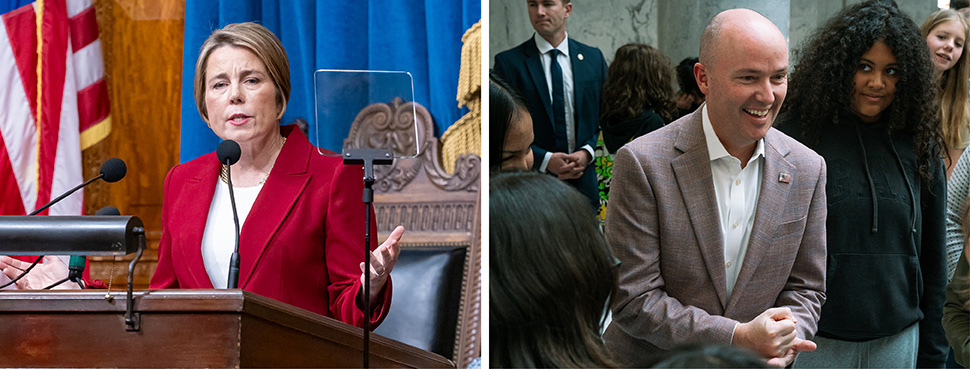
Top image: Massachusetts Governor Maura Healey and Utah Governor Spencer Cox each address their state about the urgent need for more housing. Photos courtesy of Henry Shifrin/Governor's Press Office and the Utah State Office of the Governor.