


Spotlight on Zoning Practice
Would Your Zoning Let Vertical Farming Grow?
Summary
- Scaling up vertical farming could improve fresh food access and local food security, but many zoning codes include regulations that can inhibit innovative agricultural practices.
- Planners and local officials can remove unintentional zoning barriers to vertical farming by establishing clear use permissions for intensive indoor agricultural operations.
- Tailoring zoning standards for vertical farming to its specific operational characteristics can help farms operate legally without negatively affecting neighboring properties.
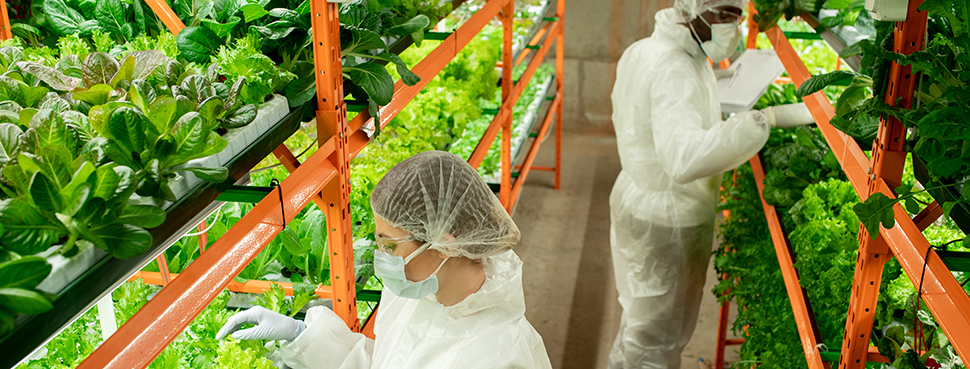
Boosters have been heralding vertical farming as the next big thing for the past decade. In that time, we've already seen two major boom and bust cycles. And now the future looks especially cloudy as shipping bottlenecks increase food, fertilizer, and energy costs. While scaling up vertical farming could shift food production closer to consumption, improving fresh food access and security, its dependency on artificial lighting and climate control makes vertical farming more vulnerable to energy price shocks than field-based agriculture.
Planners and local officials don't control access to capital and have limited tools to help vertical farmers control operational costs. But they do have an important role to play in establishing a supportive policy environment for vertical farming. As Rhys Wilson, AICP, and Melissa Ruth, AICP, note in the May issue of Zoning Practice, "Fertile Zoning for Vertical Farming," many zoning codes include regulations that create unintentional barriers to innovative agricultural practices. And very few include standards that align with the physical and operational characteristics of vertical farms.
Fill the Regulatory Gaps
Because contemporary zoning codes seldom explicitly reference vertical farming, prospective operators cannot easily determine whether a particular site or structure would be a permissible location. Consequently, in many cases, the zoning administrator would need to make an application-specific determination about whether a proposed farm was substantially similar to some other defined use before considering its compliance with zoning standards.
According to Wilson and Ruth, planners and local officials can fill this regulatory gap by either defining vertical farming as a distinct use or defining a broader use category in such a way as to unambiguously include vertical farming activities. This opens a path to by-right zoning approvals.
Tailor Standards to Impacts
Apart from clear use permissions, vertical farms need appropriate zoning standards to operate legally without negatively affecting neighboring properties. Wilson and Ruth note that standards tailored to fit the physical characteristics of outdoor urban farms may place unnecessary limits on wholly indoor operations, while failing to address impacts associated with more intensive uses.
For example, large vertical farms could have noise or traffic impacts not contemplated by zoning standards intended to address small outdoor farms on urban lots. This doesn't necessarily mean that vertical farms need extensive use-specific standards. While truck traffic and some noise from controlled environment agriculture may require special treatment in residential districts, they may not in mixed-use and nonresidential districts with comparably intense commercial or light industrial uses.
Subscribe to Zoning Practice
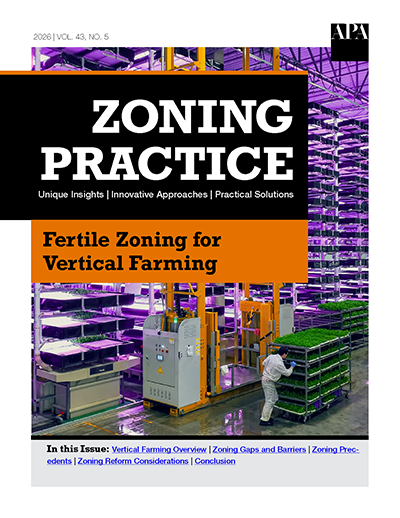
Each issue of Zoning Practice provides practical guidance for planners and land use attorneys engaged in drafting or administering local land use and development regulations. An annual subscription to ZP includes access to the complete archive of previous issues.
Top image: Pressmaster / iStock / Getty Images Plus