

Spotlight on Zoning Practice
How Can We Fix Zoning’s Blank-Slate Bias?

Summary
- Zoning regulations often seem biased toward "blank-slate" development, creating barriers for new uses or structures on previously developed sites.
- Increasing flexibility in zoning form and use standards can support the reuse and redevelopment of existing buildings.
- Clearer zoning criteria and a greater reliance on administrative approvals can facilitate more equitable and cost-efficient redevelopment and reuse.
Zoning regulations often imply that most development and changes in use happen on a "blank slate" rather than previously developed sites. This can make it difficult for planners and local officials in many communities to leverage zoning to respond to changes in employment patterns, consumer behavior, and economic trends. For example, recent improvements in the market for office space seem to be due in part to conversions to other uses, but many zoning codes make it difficult to convert offices to housing.
Retail sites face similar challenges. E-commerce has shifted brick-and-mortar demand from large-scale regional shopping centers to smaller neighborhood shops, but new uses for old structures are much more common than total site transformations.
Despite the potential benefits of redevelopment and reuse, zoning regulations often create inadvertent obstacles for these projects. Both substantive zoning standards, such as form requirements and permissible uses, and procedural standards, such as discretionary review criteria and public hearing requirements, can introduce challenges for applicants.
The June issue of Zoning Practice, "Better Zoning for Reuse and Redevelopment," by Donald L. Elliott, FAICP, explores these challenges and offers strategies that planners and local officials can use to better align regulations with practical realities. So, how can we leverage zoning to advance community priorities through redevelopment and reuse?
Be Loose on Form and Use
Addressing challenges of regulatory zoning can be accomplished through greater flexibility in both form and use standards. Existing structures have unique constraints that may make compliance with zoning regulations unattainable. Form controls that necessitate specific frontage types, height requirements, setbacks, etc., along with overly specific use distinctions, raise impractical expectations that favor new construction. Adapting regulations to better reflect the needs of redevelopment projects can alleviate some of these concerns.
To accommodate redevelopment, Elliot recommends offering full or partial exemptions to form-based controls for existing buildings, recognizing the potential limitations these structures might face with traditional form-based codes.
Additionally, broadening overly specific land use definitions provides opportunities for these buildings to adapt to the changing community needs, eliminating the need to undergo an extensive rezoning process. These adjustments to zoning standards can encourage reuse and redevelopment; however, the approval process poses its own set of barriers.
Make It Easier to Say 'Yes'
Even if a development meets the zoning form standards and allowed uses, lengthy and confusing review procedures create uncertainty for reuse and redevelopment projects. Elliot discusses how subjective language in the zoning criteria can make approval dependent on interpretation rather than compliance.
Additionally, reliance on public hearings inadvertently favors the opinions of those with more time, resources, or familiarity with the planning process. Planners and local officials can address some of these challenges through more efficient approval procedures.
According to Elliot, there are several ways to streamline the zoning approval process. Clear, objective zoning criteria reduce arbitrary deliberation as well as the need for discretionary hearings.
Administrative adjustment provisions, which allow modifications to site-specific zoning standards, can be utilized during the review process. Implementing a straightforward zoning approval process alongside flexible zoning regulations can effectively support reuse and redevelopment projects that can adapt to evolving community demands.
Subscribe to Zoning Practice
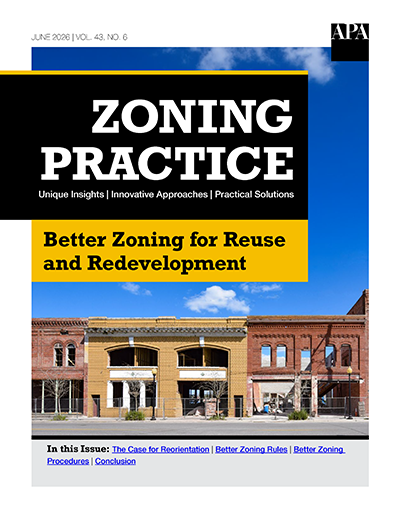
Each issue of Zoning Practice provides practical guidance for planners and land use attorneys engaged in drafting or administering local land use and development regulations. An annual subscription to ZP includes access to the complete archive of previous issues.
Top image: EJ_Rodriquez / iStock Editorial / Getty Images Plus