


Spotlight on Zoning Practice
Could a Zoning Overlay Turn the Tide on Coastal Resilience?
Summary
- Planners need new tools to mitigate climate-related risks in coastal communities.
- One such tool is the Coastal Hazards Overlay District (CHOD), new type of zoning overlay that encourages communities to diversify their risk reduction strategies.
- Planners can select from 51 potential CHOD design standards and planning techniques to tailor strategies to specific local conditions.
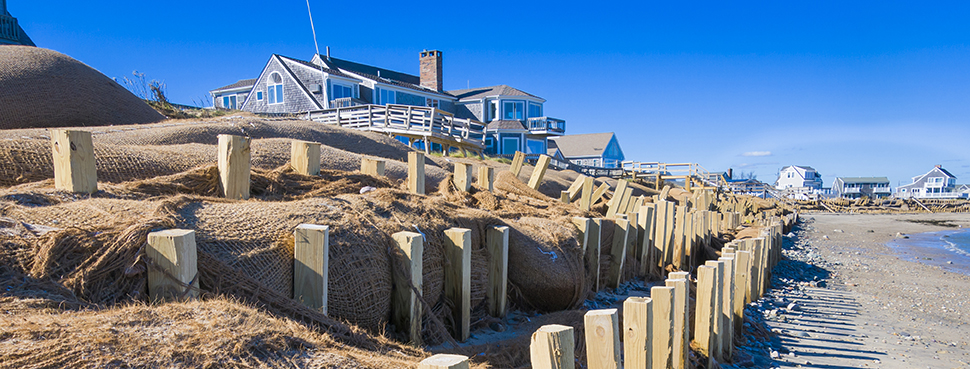
Planners in coastal communities face the daunting challenge of mitigating risks associated with even more frequent and severe storms, flooding, and other climate-induced hazardous events. For some communities, the stakes are existential. For example, researchers are warning that New Orleans has already reached a "point of no return." Without drastic interventions, rising sea levels and subsidence of the coastline will make managed retreat an unavoidable reality before the end of the century. To help other communities avoid reaching this point, planners need robust and adaptable approaches to turn the tide on coastal resilience.
In the July issue of Zoning Practice, "Putting Coastal Hazards Overlay Districts on the Map" Gavin Smith, FAICP, outlines the core features of a new evidence-backed type of zoning overlay that planners can leverage to mitigate natural hazard risk and enhance climate resilience. The potential superpower of the Coastal Hazards Overlay District (CHOD) is its ability to accommodate multiple resilience strategies through a wide range of techniques that can help planners and local officials craft context-specific responses.
CHODs Support Diversified Risk Reduction Strategies
As climate change worsens, coastal communities will need to diversify their risk reduction strategies. Smith notes that an overreliance on a single technique can leave communities even more vulnerable to compounding hazard risks. For instance, relying on seawalls or levees for protection often creates a false sense of security, while relying exclusively on managed retreat can be impractical and inequitable. Instead, planners should work to employ a multitude of strategies that can be monitored and adapted to better support resilience in these communities.
Smith explains that the CHOD was designed around four approaches to resilience: avoidance, protection, accommodation, and community-led relocation. Using CHOD to implement measures that support a mix of these approaches offers a more comprehensive approach to climate risk reduction. CHODs can also shift alongside changing climate conditions through revised boundaries or design techniques. Not only does CHOD offer a flexible approach to address climate related threats, but it can also be adapted to fit the context of various places.
CHODs Respond to Local Conditions
To effectively plan for hazards, planners should consider the context of an area. While coastal zones experience similar threats from climate change, the existing conditions of communities will vary. Conditions such as intensity of development and development patterns within a community will likely play a role in deciding which specific design standards and planning techniques are most feasible and appropriate in different areas.
Smith highlights 51 distinct standards and techniques that planners and local officials can integrate into new CHODs to advance different resilience objectives and respond to local conditions. For example, intensely developed areas may prioritize investments in elevated roadways for evacuation, while low-intensity areas might opt for strategies like community-led relocation or buy-outs. Similarly, CHODs can designate lower-risk areas as development receiving zones to steer new development away from higher-risk areas.
Subscribe to Zoning Practice
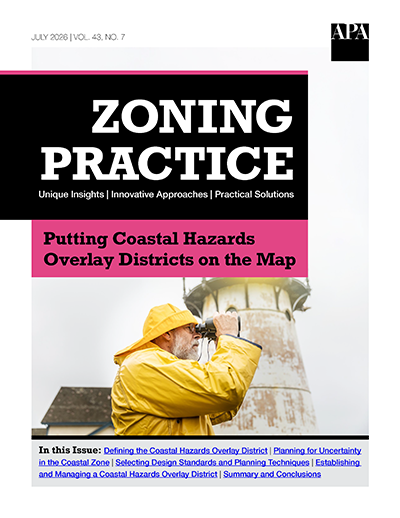
Each issue of Zoning Practice provides practical guidance for planners and land use attorneys engaged in drafting or administering local land use and development regulations. An annual subscription to ZP includes access to the complete archive of previous issues.
Top image: KentWiedemann / iStock Unreleased